

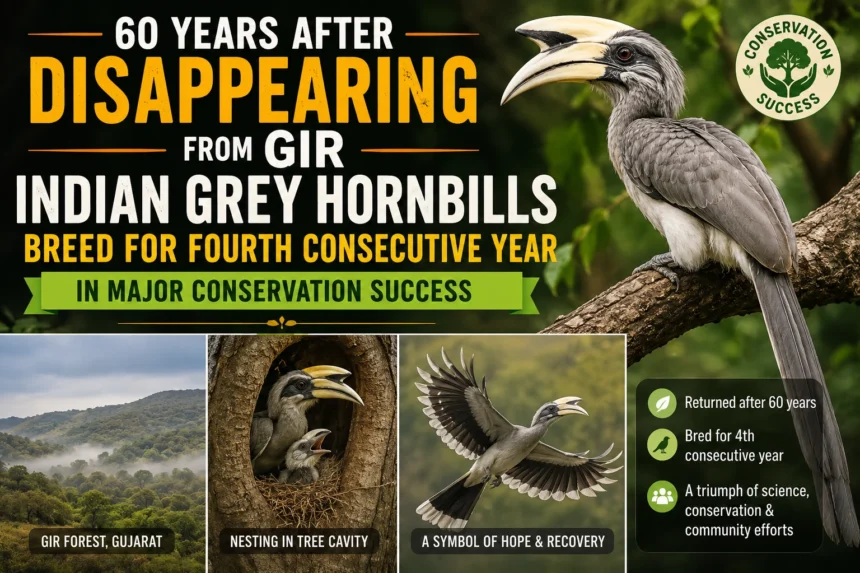
In a remarkable victory for wildlife conservation, the Indian Grey Hornbill has successfully established a breeding population in Gujarat’s Gir Forest more than six decades after disappearing from the region. Conservationists have confirmed that the birds have now bred successfully for the fourth consecutive year, marking one of India’s most successful bird reintroduction programmes in recent decades. (The Economic Times)
The achievement is particularly significant because the species had been considered locally extinct in Gir since the 1950s–60s. Through careful scientific planning, habitat restoration, and continuous monitoring, the Gujarat Forest Department has managed to restore a thriving hornbill population in one of India’s most iconic forest ecosystems.
A Bird That Vanished for More Than Six Decades
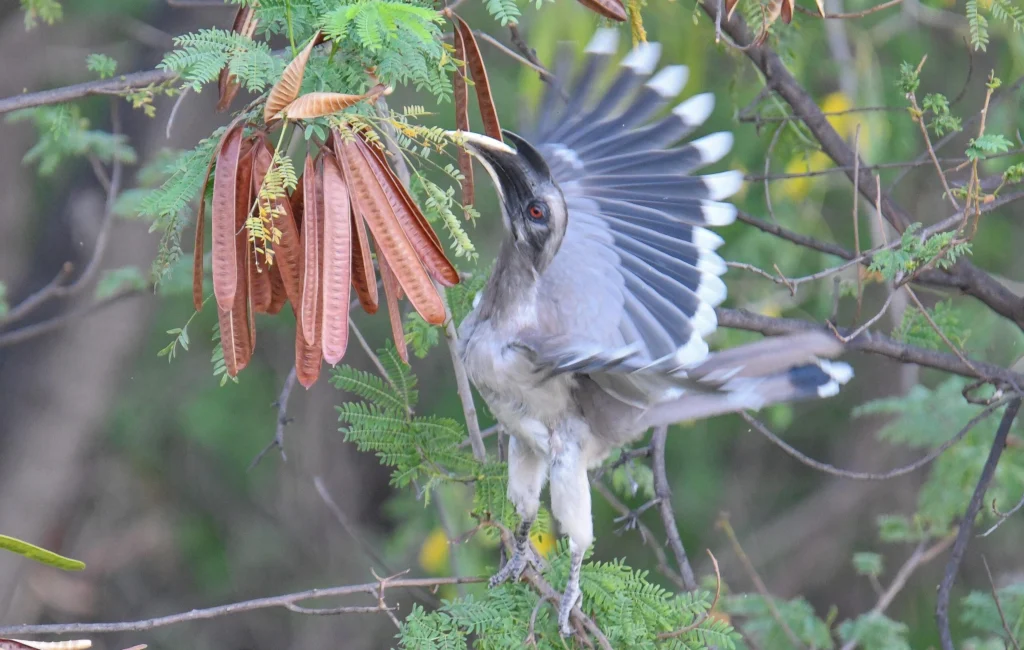
The Indian Grey Hornbill (Ocyceros birostris) was once a familiar sight in the Gir landscape. Historical records indicate that the species inhabited the forests until the mid-20th century before gradually disappearing.
Although the exact reason for its disappearance remains uncertain, experts believe a combination of habitat degradation, changes in forest structure, loss of mature nesting trees, and ecological changes contributed to its local extinction.
Despite surviving in other parts of Gujarat and across much of the Indian subcontinent, the species had been absent from Gir for over 60 years.
The Reintroduction Programme
Recognising the ecological importance of hornbills, the Gujarat Forest Department launched a scientific reintroduction programme in 2021.
The initiative involved:
- Careful habitat assessment.
- Identification of suitable nesting sites.
- Selection of healthy birds from Aravalli forests.
- Veterinary examinations.
- GPS and satellite tracking.
- Long-term behavioural monitoring.
In total, 40 Indian Grey Hornbills were released in two phases—28 birds during 2021–22 and another 12 during 2023. Several male birds were fitted with satellite transmitters to study their movements and adaptation. (The Economic Times)
Fourth Consecutive Year of Successful Breeding
The most encouraging outcome of the programme is that the reintroduced birds have not merely survived—they have established territories and reproduced successfully.
A recent scientific study confirms that the hornbills have now bred successfully for four consecutive breeding seasons, indicating that the population is becoming self-sustaining rather than relying solely on released individuals. (The New Indian Express)
Researchers observed:
- Stable breeding territories.
- Successful nesting in natural tree cavities.
- Multiple breeding pairs.
- Healthy offspring surviving into adulthood.
- Reduced long-distance movement, suggesting permanent settlement.
These findings demonstrate that the birds have adapted well to the Gir ecosystem.
Why Hornbills Matter
Indian Grey Hornbills are often called the “gardeners of the forest.”
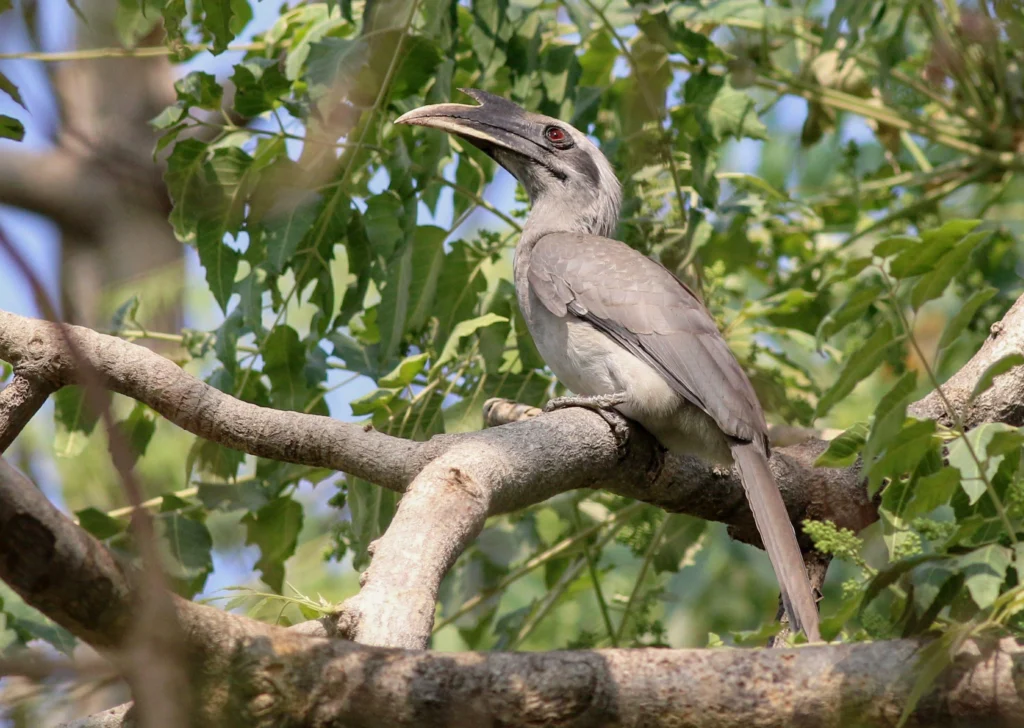
They feed primarily on:
- Figs.
- Wild berries.
- Fruits.
- Insects.
- Small reptiles.
As they move through forests, they disperse seeds over long distances, helping regenerate native vegetation and maintain healthy ecosystems.
Without seed-dispersing birds like hornbills, forest regeneration slows considerably.
Unique Breeding Behaviour
Hornbills have one of the most fascinating breeding strategies among birds.
During nesting:
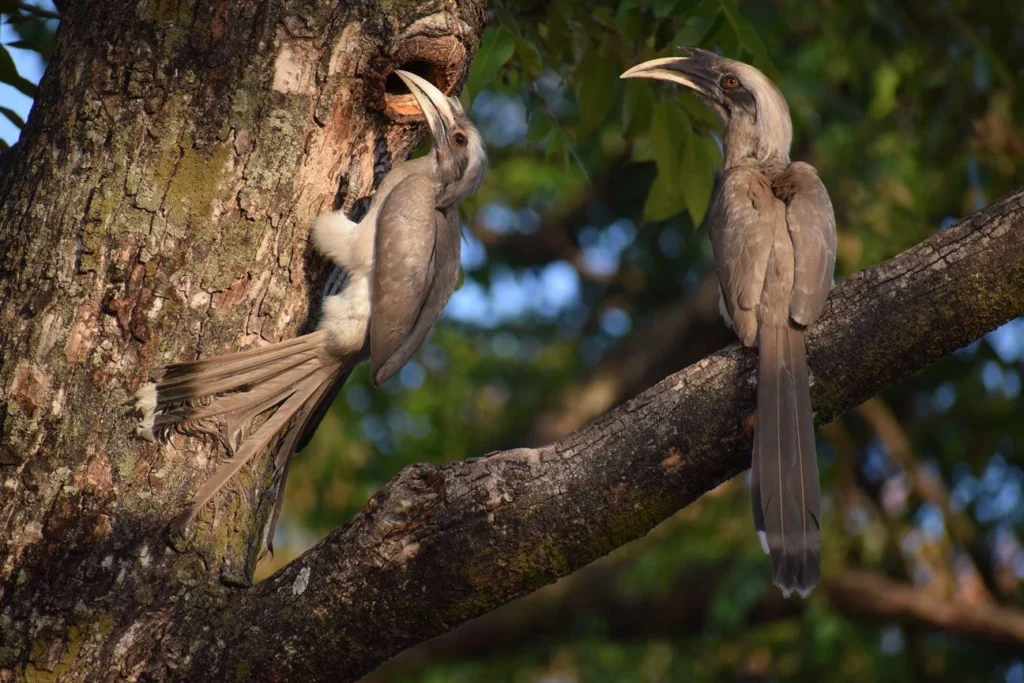
- The female enters a tree cavity.
- She seals herself inside using mud, fruit pulp, and droppings, leaving only a narrow slit.
- The male remains outside.
- He feeds the female and later the chicks through the opening.
- Once the chicks are large enough, the female breaks out of the cavity.
This unusual behaviour protects eggs and chicks from predators while making successful breeding highly dependent on mature trees with suitable nesting cavities. (MDPI)
Scientific Monitoring Played a Key Role
Unlike many earlier wildlife introductions, the Gir project relied heavily on technology.
Researchers used:
- GPS telemetry.
- Satellite transmitters.
- Habitat mapping.
- Behavioural observation.
- Nest monitoring.
- Seasonal movement analysis.
The data showed that as the birds became familiar with Gir, their home ranges gradually shrank—a positive sign that they were finding adequate food and nesting resources locally rather than wandering widely.
Habitat Restoration Supported the Comeback
Reintroducing a species requires more than releasing animals into the wild.
The success of the programme also depended on:
- Protecting mature trees.
- Restoring native vegetation.
- Conserving fruit-bearing species.
- Limiting habitat disturbance.
- Strengthening anti-poaching measures.
- Continuous ecological monitoring.
Forest officials also worked with local communities to improve awareness about the ecological value of hornbills.
Gir: More Than the Home of Asiatic Lions
Gir National Park is internationally renowned for its Asiatic lion population, but the forest supports hundreds of other species.
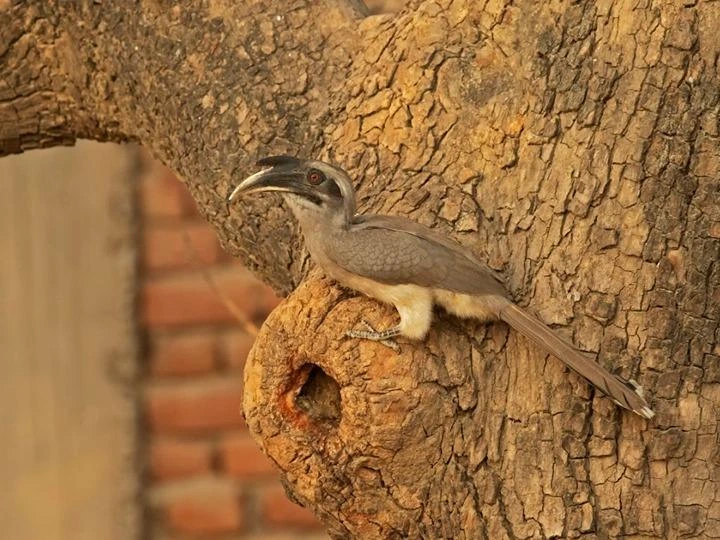
The return of the Indian Grey Hornbill highlights the park’s broader biodiversity significance.
Gir now provides habitat for:
- Asiatic lions.
- Leopards.
- Striped hyenas.
- Chital.
- Sambar deer.
- Nilgai.
- Marsh crocodiles.
- More than 300 bird species.
The hornbill’s return further strengthens Gir’s ecological diversity. (The Times of India)
Conservation Success Builds on Other Achievements
The Gujarat Forest Department recently celebrated another milestone with the survival of the second Great Indian Bustard chick produced using the innovative “jump-start” conservation technique.
The hornbill programme represents another example of India’s increasing focus on science-based wildlife recovery rather than merely protecting existing populations. (The Economic Times)
Challenges Ahead
Despite the encouraging results, conservationists caution that long-term success will depend on continued protection.
Key challenges include:
- Loss of old nesting trees.
- Climate change.
- Human disturbance.
- Habitat fragmentation.
- Expansion of infrastructure.
- Declining fruiting tree diversity.
Continuous monitoring remains essential to ensure the growing hornbill population remains healthy.
Importance for India’s Biodiversity
Species reintroduction has become an increasingly important conservation strategy worldwide.
Successful examples demonstrate that:
- Lost species can return.
- Ecosystems can recover.
- Scientific conservation delivers measurable results.
- Biodiversity restoration benefits entire landscapes.
The Gir hornbill programme may now serve as a model for similar initiatives across India.
What Scientists Say
Researchers involved in the programme believe the evidence suggests the population is moving toward long-term stability.
The birds have:
- Adapted to Gir’s climate.
- Established permanent territories.
- Used natural nesting cavities.
- Produced multiple generations of offspring.
- Displayed normal feeding and breeding behaviour.
Such indicators are considered strong signs of a successful wildlife reintroduction. (MDPI)
Conclusion
The return of the Indian Grey Hornbill to Gujarat’s Gir Forest after more than six decades represents a landmark achievement in Indian wildlife conservation. What began as a carefully planned reintroduction in 2021 has evolved into a thriving conservation success story, with the birds breeding successfully for four consecutive years.
This milestone demonstrates how scientific planning, habitat restoration, modern tracking technology, and sustained conservation efforts can restore species once thought lost from a region. As the hornbills establish self-sustaining populations and continue to regenerate the forest through seed dispersal, their comeback stands as a powerful symbol of ecological recovery and hope for biodiversity conservation in India.
Read More : – Keibul Lamjao National Park: A Floating Paradise Found Only in India