

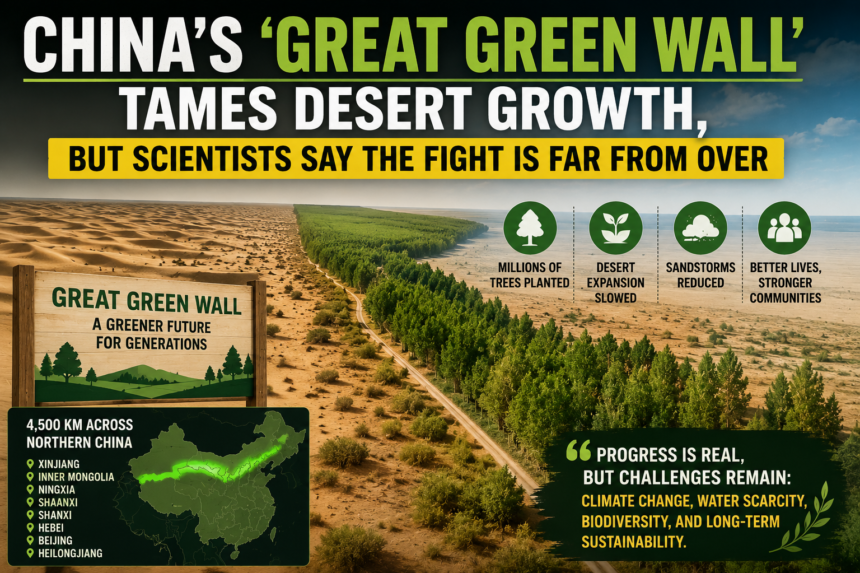
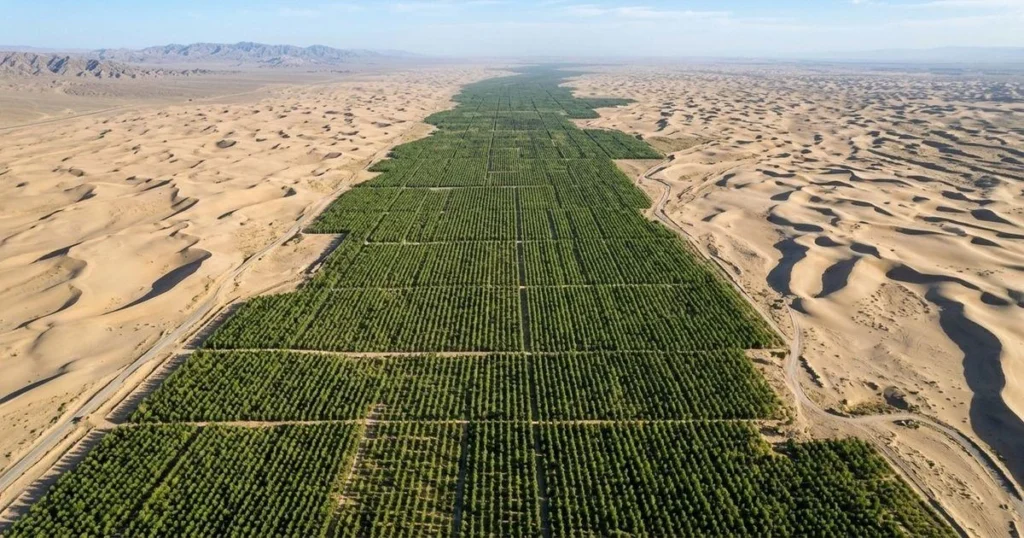
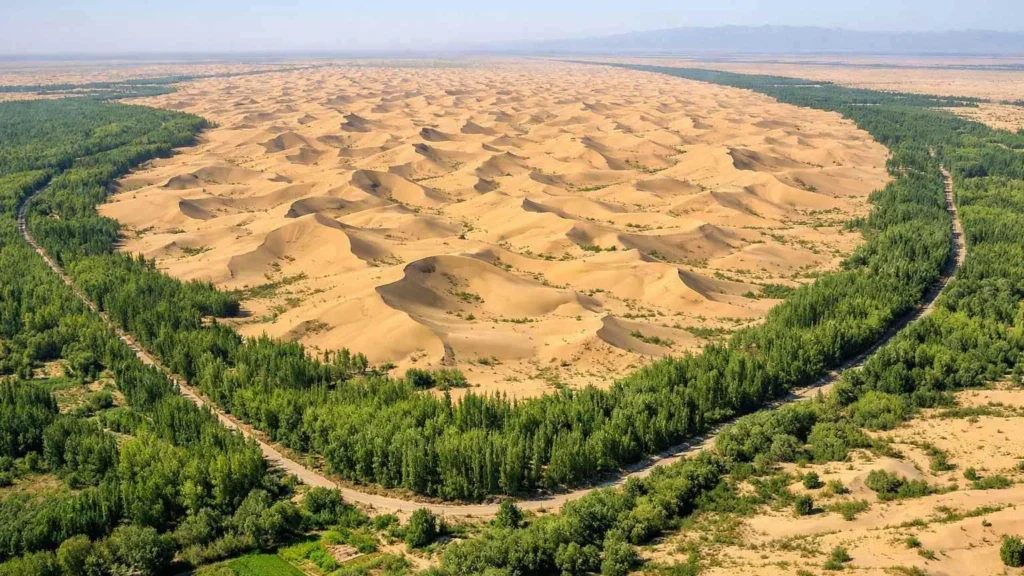
China’s decades-long effort to halt the advance of deserts through its ambitious “Great Green Wall”, officially known as the Three-North Shelterbelt Forest Program, has become one of the world’s largest ecological restoration projects. Stretching across thousands of kilometres, the initiative has transformed vast barren landscapes into green belts, significantly slowing the spread of desertification and reducing the frequency of destructive sandstorms that once plagued northern China.
While recent studies and satellite observations suggest the project has achieved remarkable success in stabilising sand dunes and improving vegetation cover, scientists caution that the battle against desertification is far from over. Climate change, water scarcity, biodiversity concerns, and the long-term sustainability of planted forests continue to pose serious challenges.
A Vision Born in the Late 1970s
China launched the Three-North Shelterbelt Forest Program in 1978 with an ambitious objective: to stop the expansion of deserts threatening millions of people across northern, northwestern, and northeastern China.
The programme covers approximately 4,500 kilometres, stretching from Xinjiang in the west to Heilongjiang in the east. Often compared to the Great Wall of China because of its immense scale, the project aims to establish extensive shelterbelts of forests capable of reducing wind erosion, protecting farmland, and restoring degraded ecosystems.
Scheduled to be completed around 2050, the initiative has already become one of the largest afforestation programmes in human history.
Why China Needed a Green Wall
Northern China contains large arid and semi-arid regions, including parts of the Gobi Desert and the Taklamakan Desert.
Rapid industrialisation, excessive logging, overgrazing, unsustainable farming practices, and prolonged drought accelerated desertification during the twentieth century. Millions of hectares of productive land gradually turned into barren desert, threatening agriculture, infrastructure, and public health.
The expanding deserts also generated massive dust storms that regularly affected Beijing and neighbouring countries, reducing visibility, damaging crops, and causing respiratory illnesses.
Recognising these growing threats, Chinese authorities launched the Green Wall project as both an environmental and economic strategy.
How the Great Green Wall Works
Rather than constructing a physical barrier, the project relies on ecological engineering.
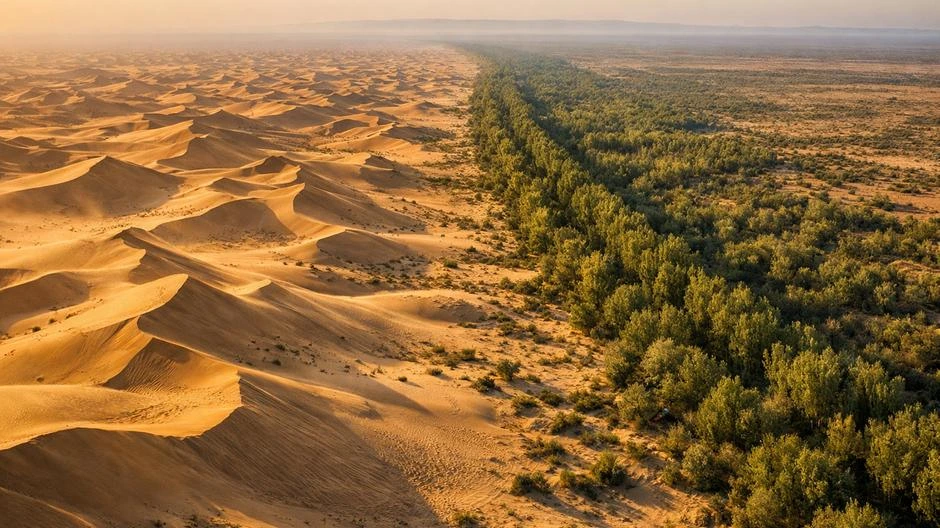
Key measures include:
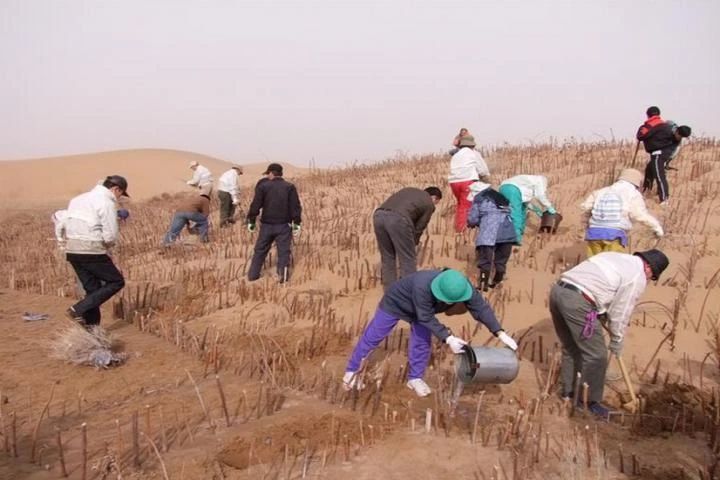
- Large-scale tree planting.
- Restoration of native grasslands.
- Stabilisation of sand dunes.
- Construction of windbreak forests.
- Soil conservation measures.
- Water management improvements.
- Controlled grazing.
- Community participation in ecological restoration.
The objective is to create vegetation capable of slowing winds, trapping moving sand, improving soil moisture, and gradually restoring ecological balance.
Measurable Success Over Four Decades
Recent satellite observations indicate that vegetation cover across many project areas has increased substantially.
Researchers report that:
- Desert expansion has slowed significantly.
- Sandstorm frequency has declined compared with previous decades.
- Millions of hectares of degraded land have been restored.
- Agricultural productivity has improved in several regions.
- Soil erosion has decreased.
- Local biodiversity has shown signs of recovery.
Cities such as Beijing now experience fewer severe dust storms than they did during the 1990s and early 2000s, demonstrating the practical benefits of improved land management.
Economic Benefits Beyond Conservation
The Great Green Wall has also generated substantial economic gains.
Improved land quality has enabled farmers to cultivate crops more effectively while protecting existing farmland from erosion.
Additional benefits include:
- Higher agricultural yields.
- Employment in forestry and conservation.
- Increased carbon storage.
- Better water retention.
- Growth of eco-tourism in restored landscapes.
- Reduced disaster-related economic losses.
The programme has become an example of how environmental restoration can contribute directly to rural development.
The Role of Modern Technology
China increasingly relies on advanced technologies to monitor and manage the project.
These include:
- Satellite remote sensing.
- Geographic Information Systems (GIS).
- Artificial intelligence for vegetation analysis.
- Drone-based monitoring.
- Climate modelling.
- Big-data platforms for ecological assessment.
These tools help scientists identify areas requiring intervention while tracking vegetation growth and desert movement with greater precision.
Scientists Welcome the Progress
Environmental researchers generally agree that the project has achieved significant ecological improvements.
Many studies have found:
- Increased vegetation density.
- Lower wind speeds in protected areas.
- Better soil stability.
- Reduced airborne dust.
- Improved local microclimates.
International environmental experts frequently cite the programme as one of the world’s most ambitious ecological restoration initiatives.
But Major Challenges Remain
Despite these achievements, scientists caution that several long-term issues remain unresolved.
One concern is that many early plantations relied heavily on single tree species, making forests vulnerable to pests, diseases, and climate stress.
Some planted trees have struggled to survive because rainfall remains extremely limited in arid regions.
Researchers argue that simply planting more trees is not always the best solution, particularly where water resources are already scarce.
Water Scarcity Is a Growing Concern
Trees require water to survive.
In many desert regions, groundwater resources are limited, raising questions about the sustainability of large-scale plantations.
Scientists warn that:
- Excessive irrigation may deplete groundwater.
- Fast-growing tree species consume large amounts of water.
- Climate change could reduce future rainfall.
- Droughts may increase tree mortality.
Future restoration efforts therefore need to prioritise species naturally adapted to dry environments.
Climate Change Adds New Risks
Climate change is expected to increase temperatures across northern China while making rainfall patterns more unpredictable.
Potential consequences include:
- Longer drought periods.
- Increased heat stress.
- More frequent extreme weather events.
- Greater wildfire risks.
- New pest outbreaks.
These factors could reduce the long-term effectiveness of existing forests unless adaptive management strategies are adopted.
Biodiversity Matters
Early phases of the project often focused on planting fast-growing commercial species.
While these trees stabilised soil quickly, they sometimes created forests with limited biodiversity.
Modern restoration strategies increasingly emphasise:
- Native tree species.
- Mixed forests.
- Grassland restoration.
- Wetland protection.
- Wildlife habitat conservation.
Ecologists argue that healthy ecosystems require diverse plant communities rather than extensive monoculture plantations.
Carbon Capture and Climate Goals
The Great Green Wall also contributes to China’s climate objectives.
Growing forests absorb atmospheric carbon dioxide through photosynthesis, helping offset greenhouse-gas emissions.
Although forests cannot replace emissions reductions from industry and energy production, they remain an important component of broader climate mitigation strategies.
The programme therefore supports China’s long-term carbon neutrality ambitions while improving environmental resilience.
Community Participation
Local communities play an essential role in maintaining restored landscapes.
Government programmes encourage residents to:
- Plant native vegetation.
- Protect forests.
- Reduce overgrazing.
- Adopt sustainable farming practices.
- Participate in ecological monitoring.
Public involvement improves long-term maintenance and ensures restoration efforts continue beyond initial planting campaigns.
Lessons for Other Countries
Several nations facing desertification—including those in Africa, Central Asia, and the Middle East—closely study China’s experience.
The project demonstrates that large-scale ecological restoration is possible when supported by long-term planning, scientific research, and sustained investment.
However, experts emphasise that restoration strategies must reflect local ecological conditions rather than simply replicating China’s model elsewhere.
The Road Ahead
The Three-North Shelterbelt Forest Program is expected to continue until 2050.
Future priorities include:
- Expanding native vegetation.
- Improving biodiversity.
- Conserving groundwater.
- Enhancing climate resilience.
- Increasing scientific monitoring.
- Strengthening local participation.
- Restoring degraded grasslands alongside forests.
Researchers believe the programme’s next phase should focus on ecosystem quality rather than simply increasing the number of trees planted.
Conclusion
China’s Great Green Wall stands as one of the most ambitious environmental restoration projects ever undertaken. Over nearly five decades, it has helped slow desert expansion, reduce destructive sandstorms, restore millions of hectares of degraded land, and improve the lives of countless communities across northern China.
Yet scientists caution that ecological restoration is an ongoing process rather than a completed mission. Climate change, water scarcity, biodiversity loss, and the sustainability of planted forests remain significant challenges. The project’s future success will depend not only on planting more trees but also on protecting ecosystems through science-based management, climate adaptation, and community participation.
As desertification continues to threaten vulnerable regions worldwide, China’s experience offers valuable lessons on both the possibilities and limitations of using large-scale ecological restoration to combat one of the planet’s most persistent environmental challenges.