

Washington, D.C. | World News | PaperPatrika
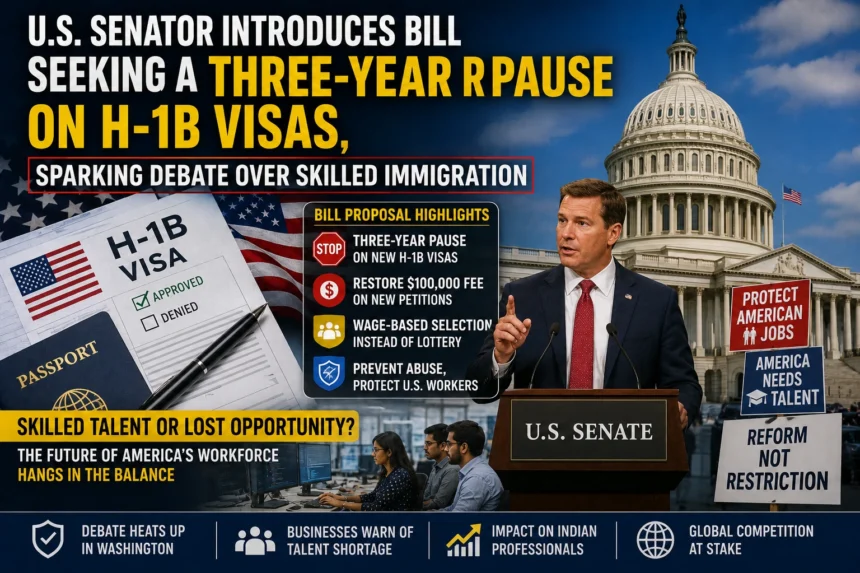
A new immigration proposal introduced in the United States Senate has reignited debate over the future of America’s high-skilled immigration system. Republican Senator Tim Sheehy of Montana has introduced legislation titled the End H-1B Abuse Act, which would suspend the issuance of new H-1B visas for 3 years while implementing sweeping reforms to the program. The bill also proposes restoring a US$100,000 fee on new H-1B petitions—a fee previously introduced by the Trump administration but later blocked by a federal court. (The Indian Express)
Although the legislation has only been introduced and has not become law, it has generated significant attention in the United States and abroad, particularly in India, whose professionals account for the majority of H-1B visa recipients.
What Is the H-1B Visa?
The H-1B visa is a non-immigrant work visa that allows U.S. employers to hire foreign professionals in specialized occupations requiring advanced knowledge and technical expertise. The program is widely used by technology, engineering, healthcare, finance, and research organizations.
Each fiscal year, the U.S. issues:
- 65,000 regular H-1B visas
- 20,000 additional visas for applicants holding advanced degrees from U.S. universities
Indian professionals constitute the largest share of H-1B beneficiaries, particularly in the information technology sector. (The Indian Express)
What the New Senate Bill Proposes
Senator Tim Sheehy’s proposal seeks a major restructuring of the H-1B program.
Among its key provisions are:
- A three-year suspension on issuing new H-1B visas.
- Making permanent the proposed US$100,000 petition fee for each new H-1B application.
- Replacing the existing random lottery with a wage-based selection system.
- Restricting third-party staffing and outsourcing models.
- Tightening employer eligibility requirements.
- Limiting several immigration benefits currently available to H-1B holders and their families. (India Today)
Supporters argue these measures would prioritize American workers, while critics warn they could reduce U.S. competitiveness in attracting global talent.
Senator Sheehy’s Argument
Introducing the bill, Senator Sheehy argued that the H-1B program was originally designed to address genuine shortages of highly skilled workers rather than serve as a source of lower-cost labor.
According to the senator, the legislation aims to ensure that employers first seek qualified American workers before recruiting internationally. He also argued that reforms are needed to prevent misuse of the visa system and restore confidence in U.S. employment practices. (The Indian Express)
Proposed US$100,000 Fee
One of the most controversial aspects of the bill is the proposal to codify a US$100,000 fee for new H-1B petitions.
The Trump administration announced a similar fee in 2025, arguing it would discourage unnecessary reliance on foreign labor. However, a federal district court ruled that the executive branch lacked authority to impose what amounted to a tax without congressional approval. More recently, a federal appeals court declined to restore that fee while litigation continues. (Reuters)
By placing the fee into legislation, supporters hope Congress—not the executive branch—would establish the legal basis for such a charge if the bill were enacted.
A Shift to Wage-Based Selection
The bill proposes replacing the current lottery-based allocation system with a wage-priority model.
Under such a system, employers offering higher salaries would receive preference in obtaining H-1B visas.
Supporters believe this approach would ensure visas are reserved for highly skilled professionals filling critical positions rather than lower-paid workers.
Opponents, however, argue that smaller businesses, universities, and startups may struggle to compete with large corporations offering significantly higher salaries. (The Economic Times)
Potential Impact on Indian Professionals
The proposal has attracted particular attention in India because Indian nationals receive a substantial majority of H-1B approvals each year.
A prolonged pause on new visa issuances could affect:
- Software engineers
- Artificial intelligence specialists
- Data scientists
- Cybersecurity professionals
- Healthcare workers
- Researchers
- Engineers
Indian IT companies that rely on H-1B visas for onsite client services could also face operational challenges if new approvals were suspended.
At the same time, existing H-1B holders would not automatically lose their current legal status simply because a new bill has been introduced; the proposal concerns future policy and would require congressional approval before taking effect. (The Economic Times)
Technology Industry Response
Many technology companies have historically defended the H-1B program, arguing that it fills genuine shortages in specialized fields.
Industry groups contend that:
- Advanced technology positions often remain difficult to fill.
- International recruitment supports innovation.
- Global talent strengthens U.S. competitiveness.
- Restrictive immigration policies may encourage companies to expand research operations outside the United States.
Business organizations are expected to monitor the bill as it moves through Congress closely. (Representative Chip Roy)
Supporters Say Reform Is Overdue
Supporters of the legislation argue that reform is necessary because some employers allegedly use the H-1B system to reduce labor costs rather than recruit exceptional talent.
According to advocates, stronger safeguards would:
- Protect American workers.
- Reduce outsourcing abuses.
- Encourage domestic hiring.
- Increase wage standards.
- Restore the program’s original purpose. (Representative Chip Roy)
Critics Warn of Economic Consequences
Immigration experts and many business groups caution that a prolonged suspension could create unintended consequences.
Potential concerns include:
- Reduced availability of specialized talent.
- Delays in technology projects.
- Higher hiring costs.
- Increased offshoring of research and development.
- Slower innovation.
Universities, hospitals, biotechnology firms, and startups that depend on international expertise may also experience recruitment challenges if access to skilled foreign professionals becomes more limited.
Legislative Outlook
While the proposal has generated significant discussion, it is important to note that introducing a bill is only the first step in the U.S. legislative process.
Before becoming law, the bill would need to:
- Pass the relevant Senate committee.
- Be approved by the full Senate.
- Pass the House of Representatives.
- Be signed by the President.
Any of these stages could lead to amendments, delays, or rejection. As a result, the proposal’s ultimate fate remains uncertain. (GovInfo)
Broader Immigration Debate
The bill reflects a broader debate in the United States over balancing economic competitiveness with domestic employment.
Supporters believe stricter immigration rules can better protect American workers and reduce abuse of temporary work visas.
Opponents argue that attracting highly skilled international professionals has long been a key factor in U.S. leadership in technology, healthcare, science, and research.
The discussion comes amid broader efforts by lawmakers to revisit employment-based immigration policies, labor protections, and visa allocation systems. (Representative Chip Roy)
Conclusion
The introduction of the End H-1B Abuse Act represents one of the most significant proposed changes to the H-1B visa program in recent years. By seeking a three-year pause on new visas, reinstating a US$100,000 petition fee through legislation, and restructuring visa allocation, the proposal has intensified debate over the future of skilled immigration in the United States.
For now, the legislation remains a proposal rather than enacted law. Nevertheless, it has drawn close attention from businesses, universities, immigration experts, and thousands of prospective applicants—particularly in India—as Congress considers whether and how the H-1B system should evolve in the years ahead.