

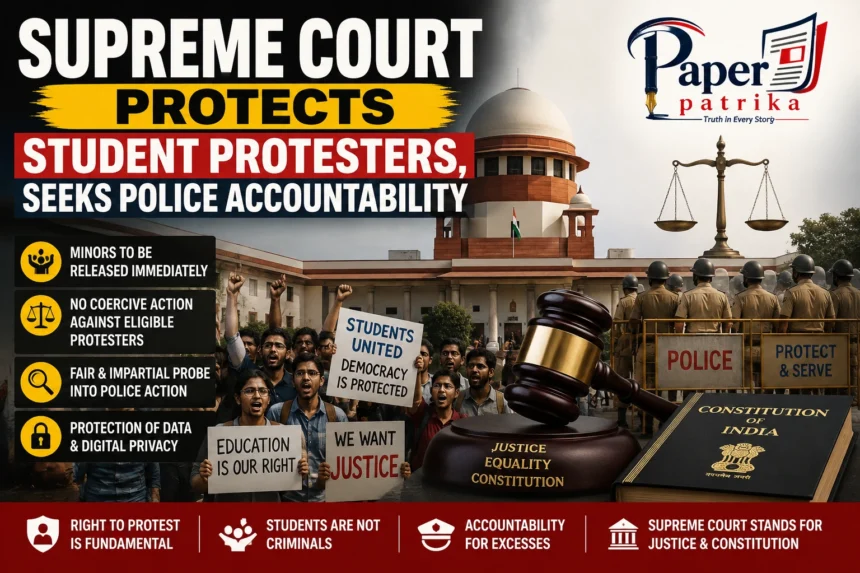
Release All Minors Held Over Student Protests: Supreme Court Orders Immediate Relief, Seeks Fair Probe into Police Action.
By PaperPatrika National Desk
In a landmark interim order balancing public order with the protection of constitutional rights, the Supreme Court of India has directed authorities across multiple states to immediately release all student protesters below the age of 18 who were arrested or detained during recent nationwide demonstrations, provided they have no criminal antecedents. The Court also extended relief to adult protesters without criminal records by directing that no coercive action be taken against them while the matter remains under judicial consideration. (The Economic Times)
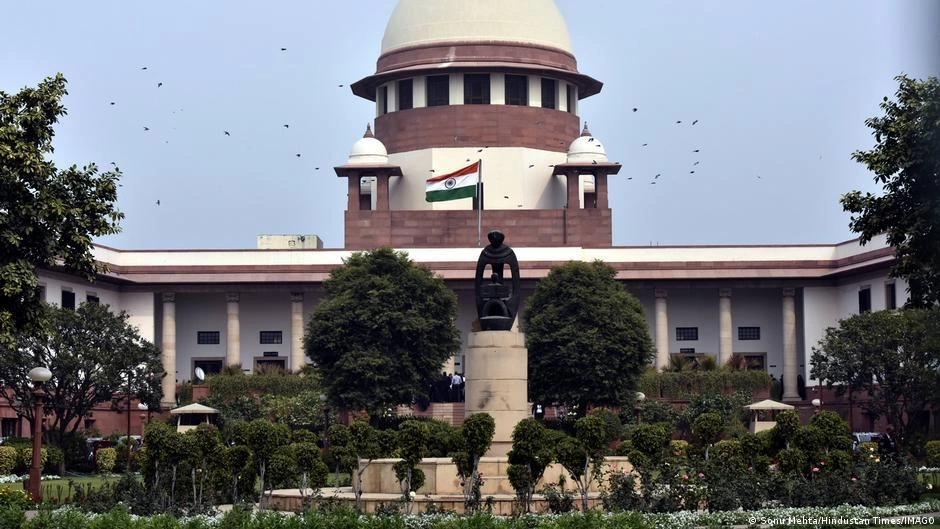
The order comes amid widespread controversy over police action during student-led protests triggered by allegations surrounding the NEET-UG 2026 examination paper leak and broader demands for accountability and reforms in India’s education system. The ruling has been widely viewed as an important affirmation of constitutional safeguards while also recognizing the need for a thorough investigation into the violence that occurred during the protests. (Reuters)
Background of the Student Protests
The nationwide demonstrations began after allegations relating to irregularities in the NEET-UG 2026 examination generated widespread public outrage. Student organizations, youth groups, and civil society activists demanded transparency, accountability, and reforms in examination management.
What started as protests over examination integrity soon evolved into a broader youth movement questioning educational governance and opportunities for students. Demonstrations took place in Delhi as well as several states including Uttar Pradesh, Bihar, Maharashtra, West Bengal, Madhya Pradesh, Assam, Kerala, and others.
In several locations, clashes occurred between protesters and police, leading to detentions, injuries, FIRs, and allegations of excessive use of force. (Reuters)
Supreme Court’s Interim Directions
Hearing a batch of petitions concerning police action during the protests, a Bench led by Chief Justice of India Surya Kant, along with Justices Joymalya Bagchi and V. Mohana, issued a series of interim directions aimed at protecting civil liberties while allowing lawful investigations to continue. (Hindustan Times)
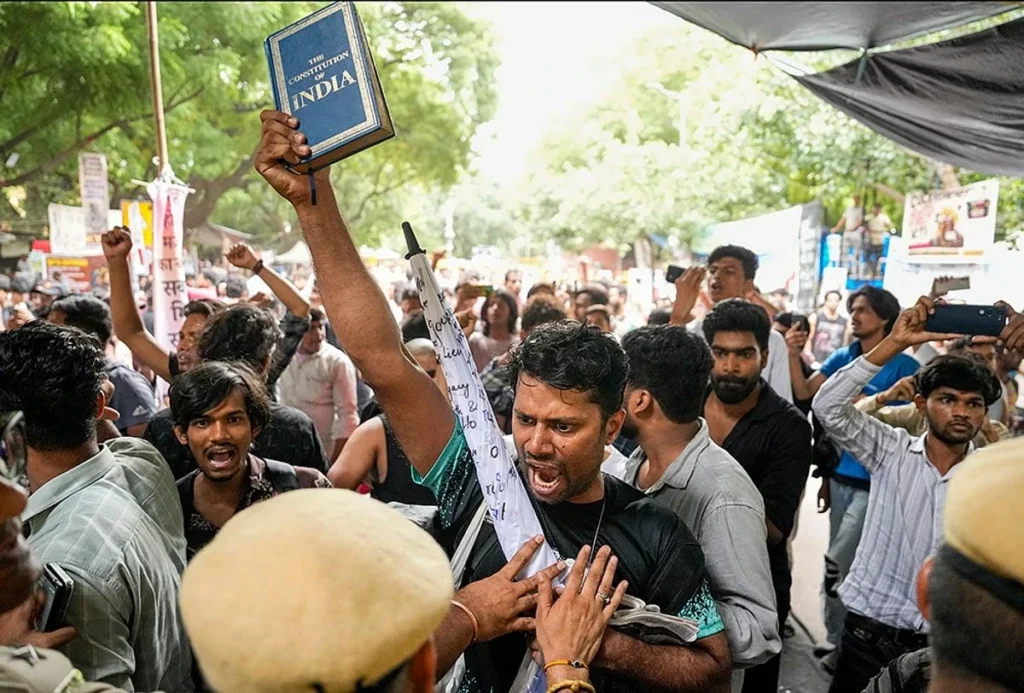
Among the most significant directions were:
- Immediate release of all detained protesters below 18 years of age who have no criminal record.
- Release of protesters without criminal antecedents where applicable.
- No coercive action against eligible protesters during the pendency of proceedings.
- Preservation of CCTV footage, drone recordings, body-camera footage, PCR logs, and other digital evidence.
- Protection of personal and digital data collected from student protesters from public disclosure.
- Continuation of investigations in accordance with law, without unnecessary coercive measures. (Live Law)
Court Emphasizes Rights of Minors
A major focus of the Court’s order was the protection of minors.
The Bench observed that children and young students require special legal safeguards and should not face prolonged detention merely because they participated in demonstrations, provided they have no criminal background.
By directing their immediate release, the Court reaffirmed the importance of juvenile justice principles and constitutional protections available to minors.
Legal experts note that this direction aligns with India’s commitment to protecting children’s rights while ensuring that criminal investigations proceed fairly and proportionately. (The Times of India)
Independent Probe into Police Action
The Supreme Court also indicated that allegations regarding police excesses deserve independent examination.
According to the Bench, the material placed before it prima facie warrants a fair and impartial inquiry into allegations involving:
- Excessive force against protesters.
- Injuries suffered by students.
- Injuries sustained by police personnel.
- Compliance with lawful crowd-control procedures.
- Accountability of officials where misconduct is established. (Live Law)
The Court indicated that it may consider constituting a high-powered or Special Investigation Team (SIT) to examine the events comprehensively after receiving responses from the Union Government and concerned state governments. (Live Law)
Preservation of Digital Evidence
Recognizing the increasing role of technology in policing and investigations, the Court ordered authorities to preserve all relevant digital evidence.
This includes:
- CCTV recordings.
- Drone footage.
- Police body-camera recordings.
- Wireless communication records.
- PCR logs.
- Electronic surveillance material.
The Court also directed that any digital information collected regarding student protesters must remain confidential and should not be made public without lawful authority. (Akashvani News)
Balancing Law Enforcement and Civil Liberties
The Court clarified that its protection is not unconditional.
Individuals with criminal antecedents or those found involved in serious criminal acts are not automatically covered by the interim relief. Investigations into alleged offences may continue in accordance with law.
This distinction reflects the Court’s attempt to balance two important constitutional objectives:
- Protecting peaceful democratic participation.
- Ensuring accountability where genuine criminal conduct exists. (Hindustan Times)
Government’s Position
During the proceedings, the government defended police action by pointing out that hundreds of police personnel were also injured during violent incidents connected with the protests.
Government representatives maintained that while peaceful protest is a constitutional right, law enforcement agencies also have an obligation to maintain public order and protect public property.
At the same time, the Centre indicated that it would cooperate with judicial directions and provide its response regarding allegations of police misconduct. (Reuters)
Importance for Student Rights
Constitutional experts believe the order has wider implications beyond the immediate controversy.
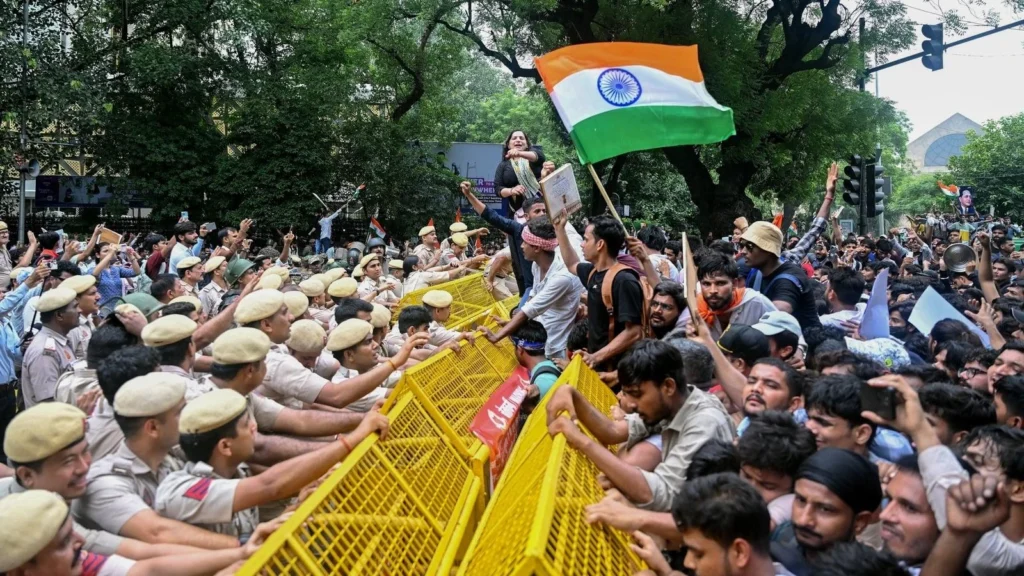
It reinforces several important legal principles:
- Peaceful protest remains a democratic right.
- Juveniles deserve enhanced legal protection.
- Police accountability is subject to judicial review.
- Digital privacy of protesters must be protected.
- Investigations should remain independent and evidence-based.
The judgment may also influence how future student demonstrations are managed by authorities across the country.
Political and Social Significance
The ruling comes after weeks of political debate over the handling of student demonstrations.
Many student organizations welcomed the order, arguing that peaceful protesters should not be criminalized. Civil rights groups also praised the Court’s emphasis on preserving evidence and ensuring an impartial investigation.
Meanwhile, governments in the affected states are expected to comply with the interim directions while filing detailed responses before the Supreme Court regarding allegations raised in the petitions. (The Economic Times)
What Happens Next?
The matter remains under consideration before the Supreme Court.
In the coming hearings, the Court is expected to:
- Review responses from the Union Government and state governments.
- Decide whether to formally constitute an independent investigation.
- Examine allegations against police officials.
- Review evidence preserved under its interim directions.
- Consider additional safeguards if necessary. (Live Law)
Conclusion
The Supreme Court’s decision to order the release of detained minors involved in the student protests marks a significant reaffirmation of constitutional protections during periods of public unrest. While allowing lawful investigations into the incidents to continue, the Court has emphasized that democratic participation, particularly by young people without criminal backgrounds, must not be met with disproportionate coercive action.
By directing the preservation of evidence, protecting protesters’ personal data, and signalling the possibility of an independent probe into allegations against both protesters and law enforcement, the Court has sought to ensure that accountability is pursued through due process rather than emotion or political pressure. As the case proceeds, its outcome could shape future standards governing the relationship between peaceful protest, policing, and civil liberties in India.
Also Read: –
‘Don’t Waste Our Time’: CJI Surya Kant Declines to Take Cognisance of Alleged Police Violence During CJP’s Parliament March