

Introduction
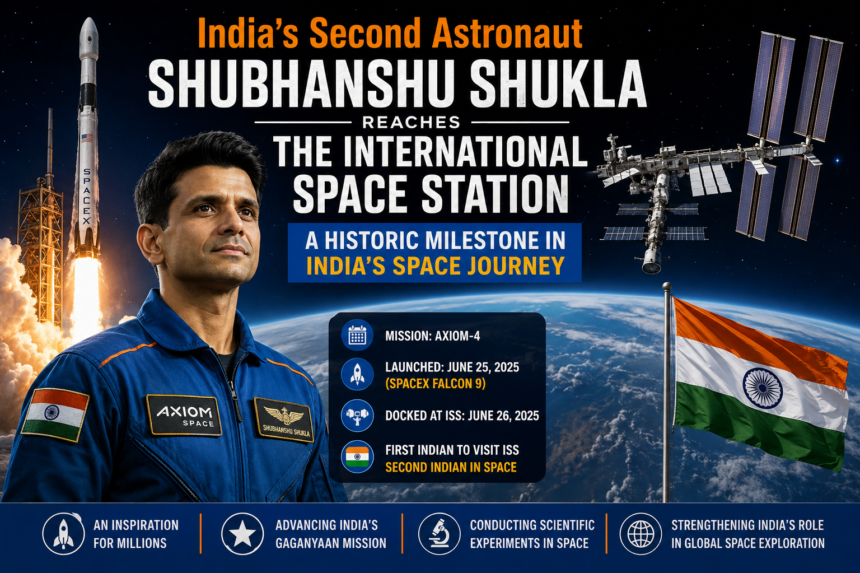
India has achieved another historic milestone in human spaceflight, with Group Captain Shubhanshu Shukla of the Indian Air Force successfully reaching the International Space Station (ISS) as part of Axiom Mission 4 (Ax-4). His journey marks a defining moment in India’s space history, making him the second Indian citizen to travel to space after Wing Commander Rakesh Sharma’s historic mission in 1984 and the first Indian to visit the International Space Station. This achievement is considered a major step toward India’s ambitious Gaganyaan Human Spaceflight Programme and highlights the country’s growing role in global space exploration.
A Historic Return to Human Spaceflight
More than four decades have passed since Rakesh Sharma became the first Indian to travel to space aboard the Soviet Soyuz T-11 mission in April 1984. His famous response, “Saare Jahan Se Achha,” when asked how India looked from space, remains one of the most memorable moments in Indian history.
Now, after 41 years, Shubhanshu Shukla has carried forward that legacy by becoming the latest symbol of India’s growing achievements in space exploration. Unlike the 1984 mission, Shukla’s journey took him to the International Space Station, one of the most advanced scientific laboratories ever built in orbit.
Who Is Shubhanshu Shukla?
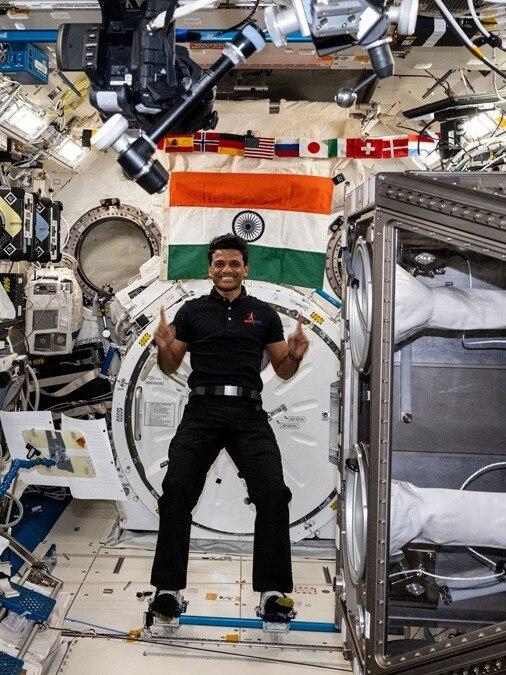
Group Captain Shubhanshu Shukla is an experienced Indian Air Force fighter pilot with thousands of hours of flying experience on multiple aircraft. Born in Lucknow, Uttar Pradesh, he completed his education before joining the National Defence Academy (NDA) and later became a commissioned officer in the Indian Air Force.
Due to his exceptional flying skills, leadership, and technical expertise, he was selected by the Indian Space Research Organisation (ISRO) as one of the astronauts for India’s Gaganyaan programme. His selection as the Mission Pilot for Axiom Mission 4 further established him as one of India’s leading space professionals.
What Is Axiom Mission 4?
Axiom Mission 4 (Ax-4) is a commercial human spaceflight mission organized by Axiom Space in collaboration with NASA and SpaceX.
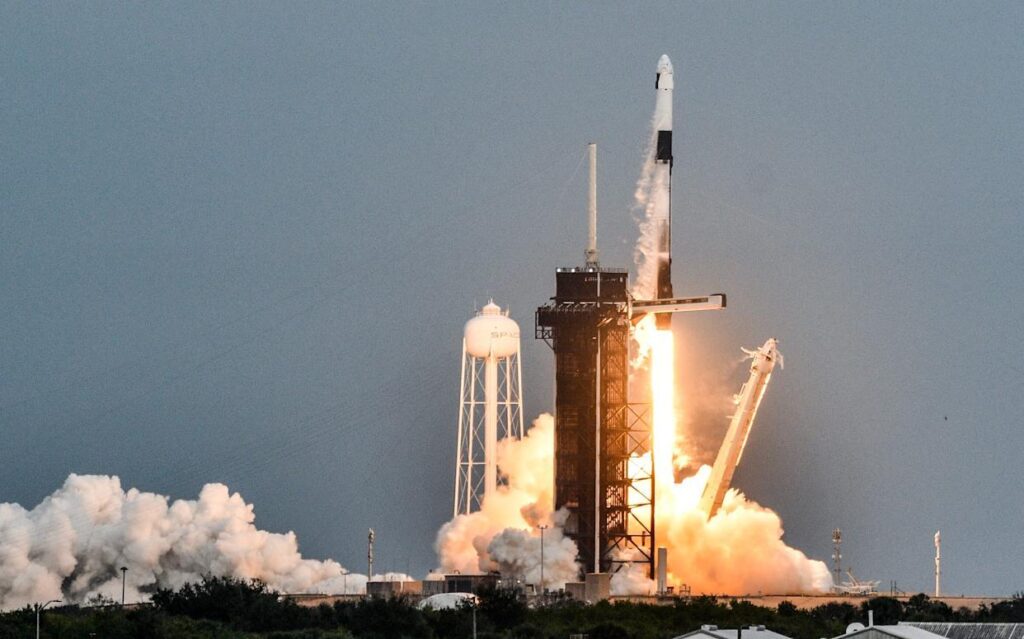
The crew launched aboard a SpaceX Falcon 9 rocket carrying a Crew Dragon spacecraft from NASA’s Kennedy Space Center in Florida.
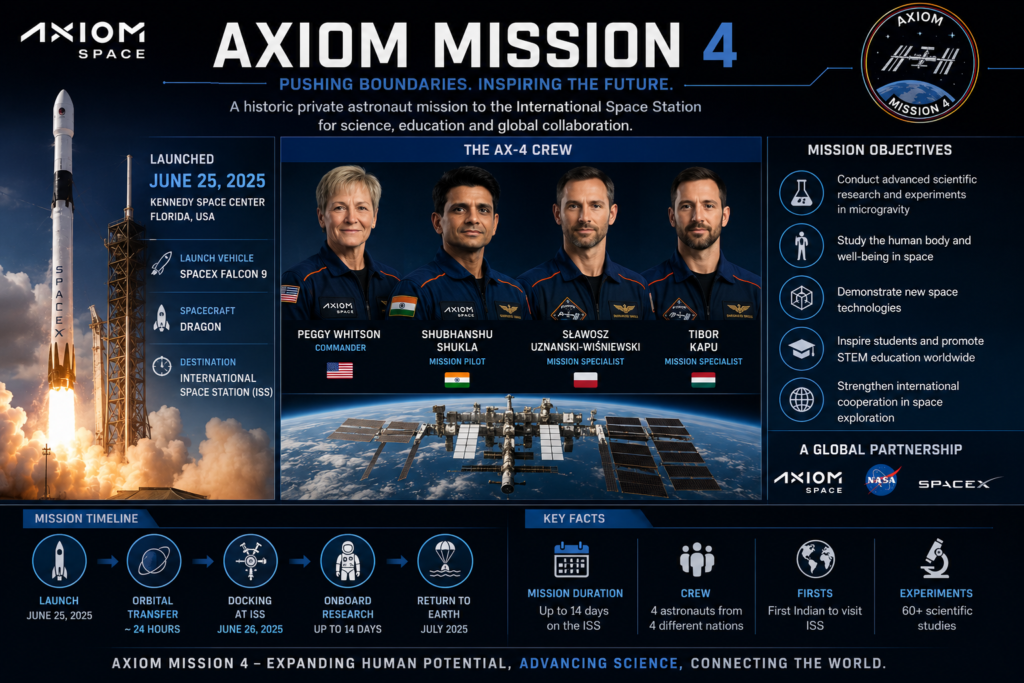
The four-member international crew included:
- Peggy Whitson (United States) – Mission Commander
- Shubhanshu Shukla (India) – Mission Pilot
- Sławosz Uznański-Wiśniewski (Poland) – Mission Specialist
- Tibor Kapu (Hungary) – Mission Specialist
The mission aimed to conduct scientific research, technology demonstrations, educational outreach, and international cooperation aboard the ISS.
Arrival at the International Space Station
After approximately one day in orbit, the Dragon spacecraft successfully docked with the International Space Station.
Following safety procedures and pressure equalization, the crew entered the ISS, where they were welcomed by astronauts already living aboard the station.
With this moment, Shubhanshu Shukla officially became the first Indian citizen to enter the International Space Station, marking another historic achievement for India’s space programme.
Scientific Experiments in Space
During his stay aboard the ISS, Shubhanshu Shukla participated in numerous scientific experiments designed by ISRO and international research institutions.
The experiments focused on:
- Human physiology in microgravity
- Muscle and bone health
- Plant growth in space
- Biological and microbial research
- Space medicine
- Advanced materials research
The data collected from these experiments will help scientists better understand how humans adapt to long-duration space missions and contribute to future lunar and Mars exploration.
Several experiments are also expected to support India’s upcoming Gaganyaan mission by improving astronaut training and mission planning.
A Major Boost for the Gaganyaan Mission
India’s Gaganyaan Programme aims to send Indian astronauts into low-Earth orbit aboard an indigenously developed spacecraft.
Although Ax-4 is a commercial international mission, the experience gained by Shubhanshu Shukla provides valuable practical knowledge for India’s first independent human spaceflight mission.
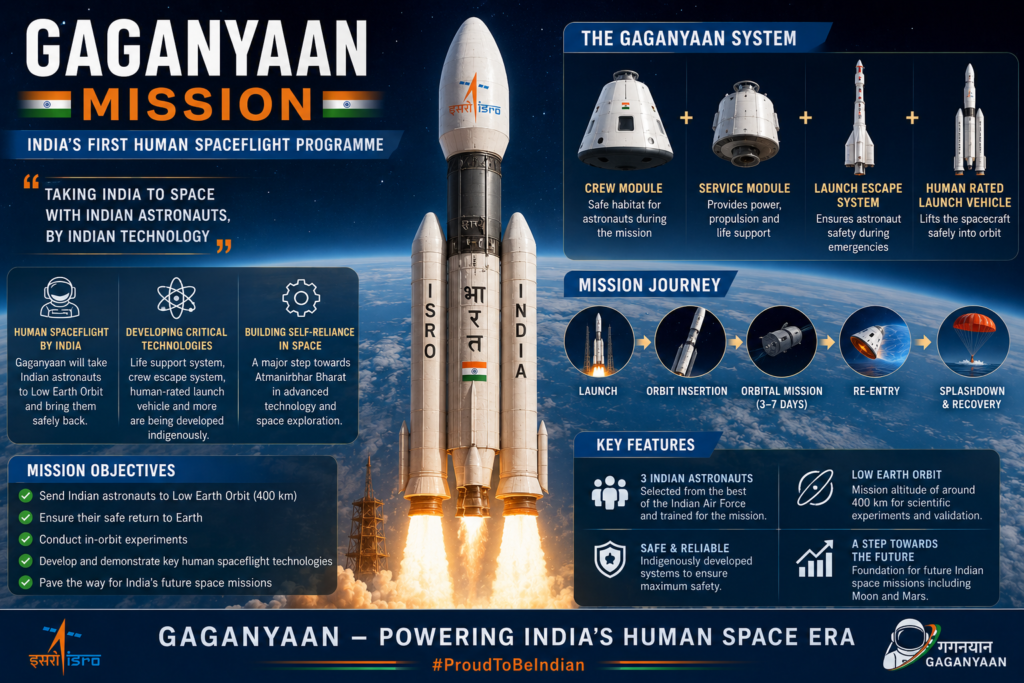
His experience includes:
- Spacecraft launch operations
- Orbital navigation
- Docking procedures
- Living in microgravity
- Scientific research in orbit
- Emergency response protocols
- International crew coordination
These experiences will contribute significantly to ISRO’s future human spaceflight missions.
A Conversation from Space
While aboard the International Space Station, Shubhanshu Shukla interacted with Indian leaders, scientists, and students through live video communication.
During these interactions, he described life in microgravity, explained the scientific work being carried out aboard the station, and encouraged young Indians to pursue careers in science, engineering, technology, and space exploration.
He emphasized that India’s future in space is extremely promising and that many more Indian astronauts are expected to travel to space in the coming years.
Inspiring the Next Generation
Shubhanshu Shukla’s journey has become a source of inspiration for millions of young Indians.
His story demonstrates that dedication, discipline, education, and perseverance can lead to extraordinary achievements.
Educators and scientists believe his success will encourage more students to choose careers in:
- Aerospace Engineering
- Space Science
- Artificial Intelligence
- Robotics
- Physics
- Aviation
- Research and Innovation
His mission represents not only personal achievement but also India’s growing scientific confidence on the global stage.
India’s Rapid Progress in Space Exploration
Shubhanshu Shukla’s mission comes during an exciting period for India’s space programme.
In recent years, ISRO has achieved several remarkable milestones, including:
- The successful Chandrayaan-3 Moon landing.
- The Aditya-L1 solar observation mission.
- Expansion of India’s commercial space sector.
- Development of the Gaganyaan human spaceflight programme.
- Increasing international collaboration with leading space agencies.
These achievements have positioned India among the world’s leading spacefaring nations and strengthened its reputation as a reliable partner in international space exploration.
International Significance
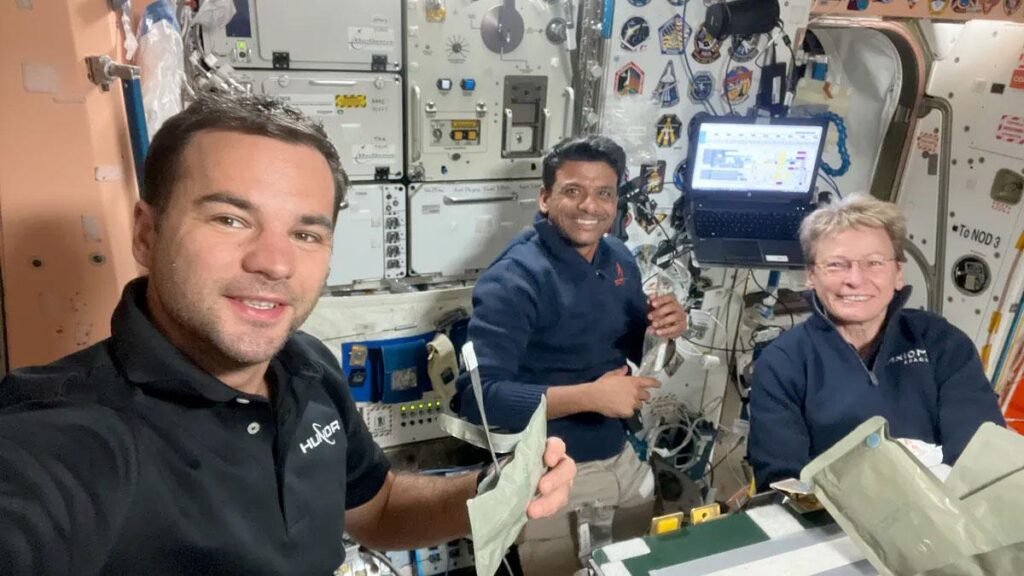
Axiom Mission 4 also highlights the growing importance of international cooperation in space exploration.
The mission brought together astronauts from four different countries, demonstrating how scientific collaboration can transcend national boundaries.
India’s participation reflects the country’s expanding influence in global space research and its commitment to contributing to humanity’s exploration of space.
Experts believe that partnerships like these will become increasingly important as future missions target the Moon, Mars, and beyond.
Conclusion
Group Captain Shubhanshu Shukla’s successful journey to the International Space Station marks one of the most significant achievements in India’s space history. Becoming the second Indian in space and the first Indian to reach the ISS is not only a personal milestone but also a proud moment for the nation.
His mission strengthens India’s preparation for the Gaganyaan programme, inspires millions of young people, and demonstrates the country’s growing capabilities in advanced science and technology. As India continues expanding its role in global space exploration, Shubhanshu Shukla’s historic mission will be remembered as a landmark achievement that opened a new chapter in the nation’s journey toward the stars.