

New Delhi | Special Report | PaperPatrika
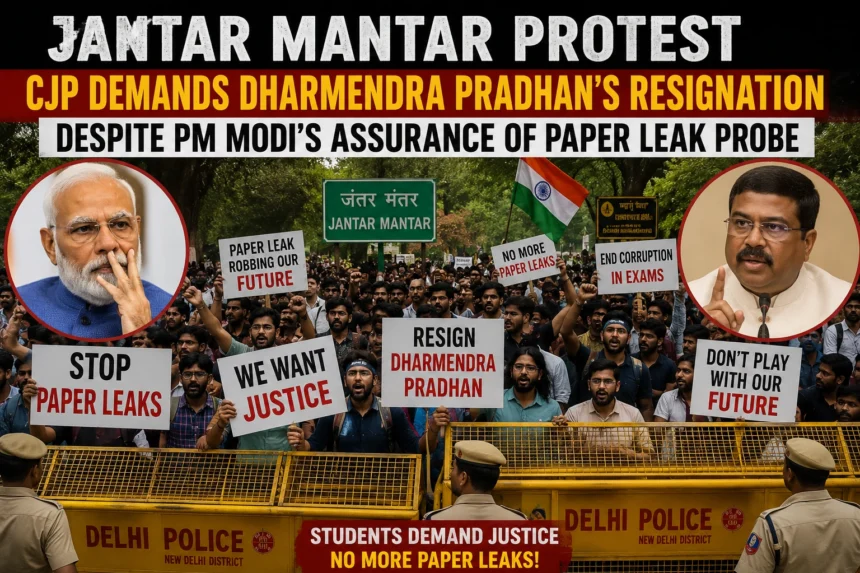
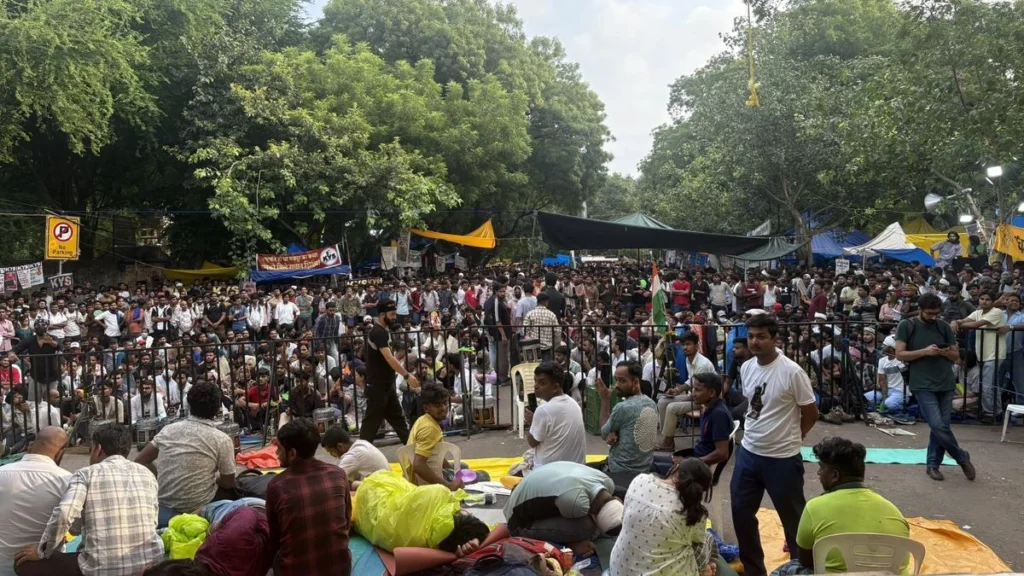
The nationwide controversy over alleged examination paper leaks has intensified, with protests continuing at Jantar Mantar in New Delhi. The Cockroach Janta Party (CJP) and several student organizations have renewed their demand for the resignation of Union Education Minister Dharmendra Pradhan, arguing that Prime Minister Narendra Modi’s assurance of a thorough investigation is not sufficient without fixing political accountability.
The demonstration comes shortly after Prime Minister Modi announced that the government would establish fast-track courts for paper leak cases and ensure strict action against those responsible for compromising the future of India’s youth. However, protest leaders insist that systemic reforms and ministerial accountability are equally necessary to restore confidence in the country’s examination system.
Background of the Protest
Public anger has been mounting over allegations of paper leaks and irregularities in several competitive examinations conducted across the country.
Millions of students spend years preparing for government recruitment and entrance examinations. Alleged leaks have resulted in cancelled exams, delayed recruitment, legal disputes, and growing frustration among aspirants.
The protests at Jantar Mantar have gradually evolved from opposition to individual examination irregularities into a broader movement demanding comprehensive reforms in India’s examination and recruitment system.
CJP’s Key Demands
The Cockroach Janta Party (CJP), along with supporting student groups, has outlined several major demands:
- Resignation or removal of Union Education Minister Dharmendra Pradhan.
- Independent and transparent investigations into all alleged paper leak cases.
- Comprehensive reforms to strengthen examination security.
- Accountability for officials responsible for administrative failures.
- Justice for students affected by cancelled or compromised examinations.
According to protest leaders, investigations alone will not restore public trust unless those responsible are held accountable.
PM Modi’s Assurance
Responding to growing public concern, Prime Minister Narendra Modi stated that the government maintains a “zero-tolerance” policy toward examination paper leaks.
He announced:
- Fast-track courts for paper leak cases.
- Expedited investigations.
- Strict punishment for offenders.
- Stronger legal action against examination mafias.
The Prime Minister emphasized that protecting the future of India’s youth remains the government’s highest priority.
Why Are Protesters Still Demonstrating?
Despite welcoming stricter legal measures, CJP leaders argue that the government’s response remains incomplete.
According to the organizers:
- Similar assurances have been made in previous cases.
- Investigations often take years to conclude.
- Administrative accountability has remained limited.
- Structural reforms are required alongside criminal investigations.
Protesters therefore insist that meaningful change requires both judicial action and political responsibility.
Heavy Security at Jantar Mantar
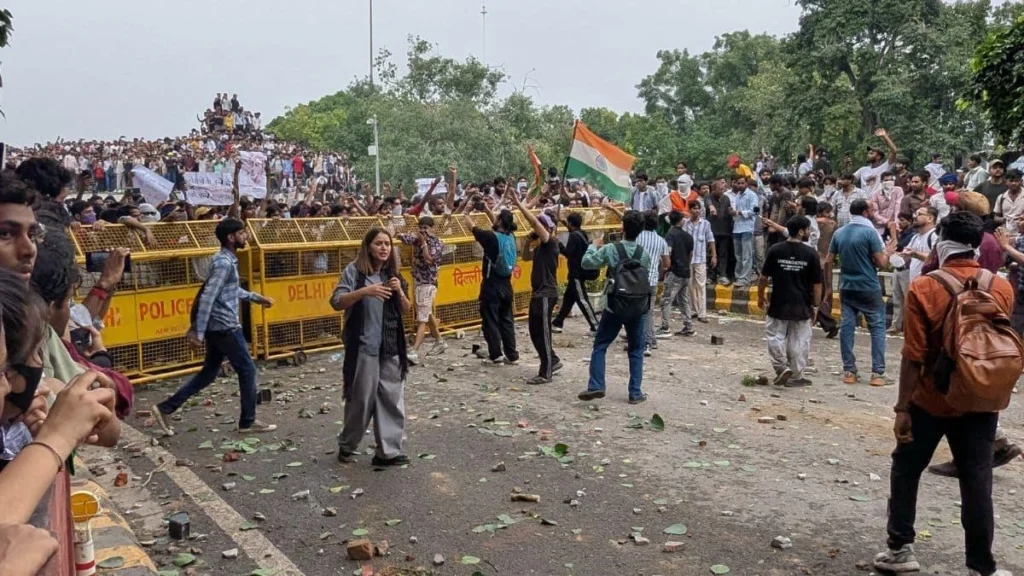
Delhi Police deployed significant security arrangements around Jantar Mantar to maintain law and order during the demonstrations.
Authorities installed barricades, regulated entry into protest areas, and monitored public gatherings closely. Traffic diversions were implemented in nearby areas as precautionary measures.
Security was heightened following recent protest marches and confrontations between demonstrators and police in parts of the capital.
Meeting with BJP President J.P. Nadda
Representatives of the protest movement met BJP National President J.P. Nadda to present their demands.
According to CJP leaders, they sought:
- Immediate action against those responsible.
- A clear roadmap for examination reforms.
- Greater transparency in recruitment processes.
Following the meeting, protest organizers stated that while discussions were held, they had not yet received satisfactory assurances addressing their principal demands.
Opposition Supports Student Protest
Several opposition leaders have voiced support for the students’ movement.
Congress leader Rahul Gandhi criticized the government’s handling of examination irregularities and renewed calls for Education Minister Dharmendra Pradhan’s resignation.
Opposition parties argue that recurring examination controversies indicate deeper institutional weaknesses that require comprehensive reform rather than isolated investigations.
Government’s Position
The central government maintains that significant steps are already underway.
Officials have highlighted:
- Stronger anti-paper leak legislation.
- Digital security improvements.
- Enhanced cyber monitoring.
- Faster investigations.
- Fast-track courts for speedy justice.
The government says these initiatives demonstrate its commitment to protecting students and ensuring fair recruitment processes.
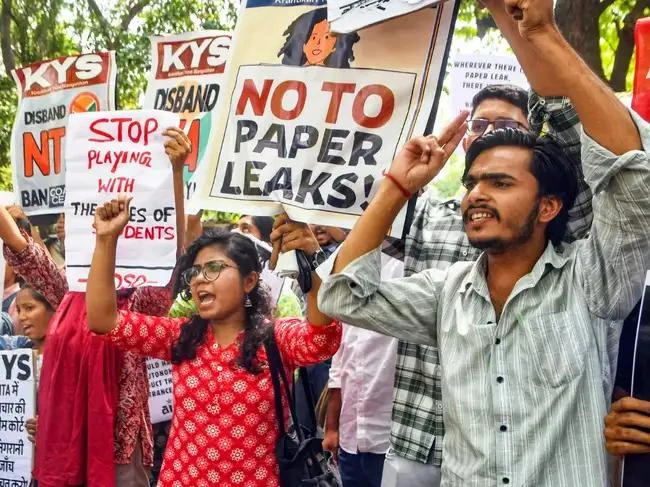
Impact on Students
The issue has affected millions of aspirants preparing for:
- Government jobs
- Medical entrance examinations
- Engineering admissions
- Teacher recruitment
- Public service commissions
- Other competitive examinations
Many students argue that repeated examination cancellations increase financial burdens, emotional stress, and uncertainty regarding their careers.
Education experts warn that continued controversies could weaken public confidence in India’s examination system unless meaningful reforms are implemented.
Experts Call for Structural Reforms
Policy analysts believe criminal prosecution alone cannot solve the problem.
They recommend:
- End-to-end encrypted question paper transmission.
- Artificial intelligence–based monitoring systems.
- Stronger cybersecurity infrastructure.
- Greater accountability of examination agencies.
- Independent audits of examination processes.
- Better coordination between central and state authorities.
Experts argue that prevention must become as important as punishment.
What Happens Next?
The government is expected to release detailed guidelines regarding the implementation of fast-track courts and additional anti-paper leak measures.
Meanwhile, CJP and student organizations have announced that protests will continue unless concrete action is taken on their demands, including institutional reforms and accountability at the highest administrative levels.
Conclusion
The ongoing protests at Jantar Mantar have transformed the issue of examination paper leaks into a national debate on educational integrity, accountability, and governance. While Prime Minister Narendra Modi’s commitment to fast-track investigations and stricter punishment signals a tougher government response, student organizations argue that lasting public confidence can only be restored through transparent reforms, institutional accountability, and stronger safeguards against future examination fraud.
As discussions continue between the government, opposition parties, and protest leaders, the coming weeks may prove crucial in determining whether the movement leads to meaningful changes in India’s examination and recruitment system.
Also Read: – ‘Don’t Waste Our Time’: CJI Surya Kant Declines to Take Cognisance of Alleged Police Violence During CJP’s Parliament March