

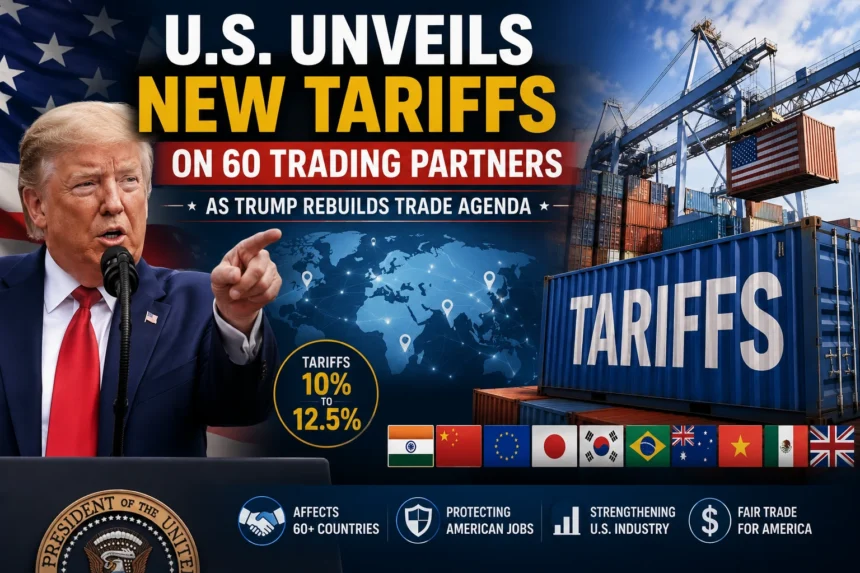
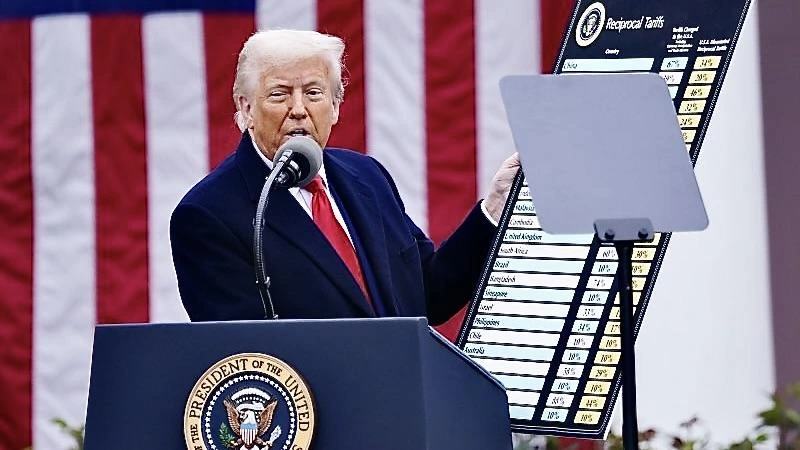
In one of the most significant trade policy announcements of his second presidential term, U.S. President Donald Trump has unveiled a sweeping new tariff regime targeting 60 trading partners. The move marks a major step in the administration’s effort to reshape America’s global trade strategy while increasing pressure on countries that, according to Washington, have failed to prevent imports produced through forced labor.
The new measures, announced by the Office of the United States Trade Representative (USTR), impose additional import duties ranging from 10% to 12.5% on goods entering the United States from dozens of economies, including India, China, the European Union, Japan, Australia, and several developing nations. The administration says the policy is intended to protect American industries, strengthen supply chain security, and encourage international labor rights compliance.
What Has the U.S. Announced?
The new tariffs have been imposed under Section 301 of the Trade Act of 1974, a legal mechanism that allows the U.S. government to take action against foreign trade practices considered unfair or harmful to American interests.
According to USTR, investigations concluded that dozens of U.S. trading partners have not implemented effective measures to prevent the import or export of products manufactured using forced labor. As a result, the administration has introduced a broad tariff framework covering nearly all affected economies.
Tariff Rates: 10% and 12.5%
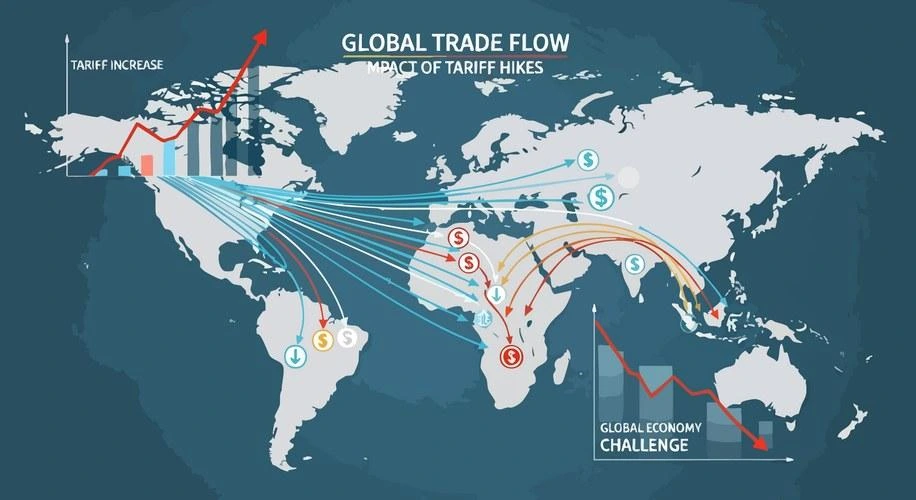
Under the new policy:
- Some countries will face a 10% tariff on specified exports to the United States.
- Others will be subject to a 12.5% tariff, depending on the findings of the USTR investigation.
- The measures reportedly cover approximately 99.4% of total U.S. imports from the targeted economies.
- Essential products such as crude oil, natural gas, fertilizers, and certain food items remain exempt, along with products covered under specific free trade agreements.
Trump’s Strategy Behind the Move
The Trump administration has described the tariffs as part of a broader effort to rebuild America’s trade agenda.
Officials argue that international trade should reward countries that uphold fair labor practices while discouraging those that benefit from exploitative production methods.
U.S. Trade Representative Jamieson Greer stated that the United States has long prohibited imports made with forced labor and now expects major trading partners to implement comparable safeguards. Countries failing to do so, he said, should not enjoy unrestricted access to the U.S. market.
A New Legal Approach After Earlier Court Challenges
The latest tariffs also represent a legal shift by the Trump administration.
Earlier reciprocal tariffs introduced this year faced significant legal challenges, with U.S. courts questioning the administration’s authority to impose them under previous statutes.
To avoid similar disputes, the administration has relied on Section 301, a well-established trade enforcement mechanism that has previously been used against countries accused of unfair trade practices, including China.
This strategy is expected to provide a stronger legal foundation for the new trade measures.
Impact on India
India is among the countries affected by the new tariff package.
However, reports indicate that India has been placed in the 10% tariff category, reflecting improvements in labor standards and import monitoring systems in recent years.
Nevertheless, Indian exporters—particularly those involved in textiles, engineering goods, chemicals, electronics, and manufactured products—could experience increased costs when selling to the U.S. market.
Trade experts believe Indian companies may need to diversify export destinations or improve competitiveness to offset the impact of higher duties.
China and the European Union Also Targeted
China, the European Union, and several other major economies are also included in the new tariff framework.
Analysts suggest that the announcement could reignite trade tensions between Washington and Beijing, particularly as China has historically responded to U.S. tariffs with retaliatory duties on American exports.
The European Union is also expected to evaluate possible responses while engaging in diplomatic discussions with U.S. officials.
Potential Impact on Global Supply Chains
The implications extend well beyond bilateral trade.
Modern manufacturing depends on complex international supply chains, where components often cross multiple borders before final assembly.
Higher tariffs on imported goods could increase production costs for industries including:
- Electronics
- Automobiles
- Pharmaceuticals
- Consumer goods
- Industrial machinery
- Renewable energy equipment
Companies may be forced to reorganize supply chains or shift manufacturing to countries facing lower tariff rates.
Will Consumers Face Higher Prices?
Economists warn that increased import duties often translate into higher prices for consumers.
If businesses pass on the added costs to buyers, American households could experience price increases across a wide range of imported products.
This comes at a time when policymakers continue to monitor inflationary pressures in the world’s largest economy.
While the administration argues that protecting domestic industries outweighs short-term price increases, critics believe consumers may ultimately bear much of the financial burden.
Possible International Response
Several affected countries are expected to review the legality of the new tariffs under World Trade Organization (WTO) rules.
Some governments may also consider retaliatory measures against American exports if negotiations fail.
Trade experts caution that a cycle of reciprocal tariffs could increase uncertainty in global commerce and slow international economic growth.
However, others believe many countries may instead seek diplomatic solutions to avoid another prolonged trade conflict similar to the U.S.–China tariff disputes of previous years.
Financial Markets React
Global financial markets reacted cautiously following the announcement.
Investors are closely monitoring:
- Potential retaliatory tariffs
- Changes in corporate supply chains
- Effects on multinational companies
- Inflation outlook
- Future trade negotiations
Analysts expect increased volatility in equity, commodity, and currency markets until greater clarity emerges regarding international responses.
What Happens Next?
The new tariff measures are scheduled to take effect immediately under the announced timeline.
The Trump administration has indicated that countries demonstrating stronger enforcement against forced labor and improved trade compliance could eventually qualify for tariff reviews or adjustments.
At the same time, officials have made clear that additional enforcement actions remain possible if trading partners fail to address U.S. concerns.
Conclusion
The Trump administration’s decision to impose new tariffs on 60 trading partners represents one of the most consequential trade policy actions of 2026.
While Washington frames the move as a necessary step to combat forced labor, strengthen domestic manufacturing, and promote fair trade, critics argue that the policy risks increasing global trade tensions, disrupting supply chains, and raising consumer prices.
For countries such as India, China, and members of the European Union, the coming months will be critical as governments, exporters, and businesses adapt to the changing landscape of international trade.
Whether the policy succeeds in reshaping global trade practices—or triggers another round of international tariff disputes—will likely become one of the defining economic stories of the year.
Also Read:- Trump’s 200% Generic Drug Tariff Threat Could Hurt American Patients, Warns Indian Pharma Industry