

Philadelphia, United States | July 27, 2026 | PaperPatrika Special Report
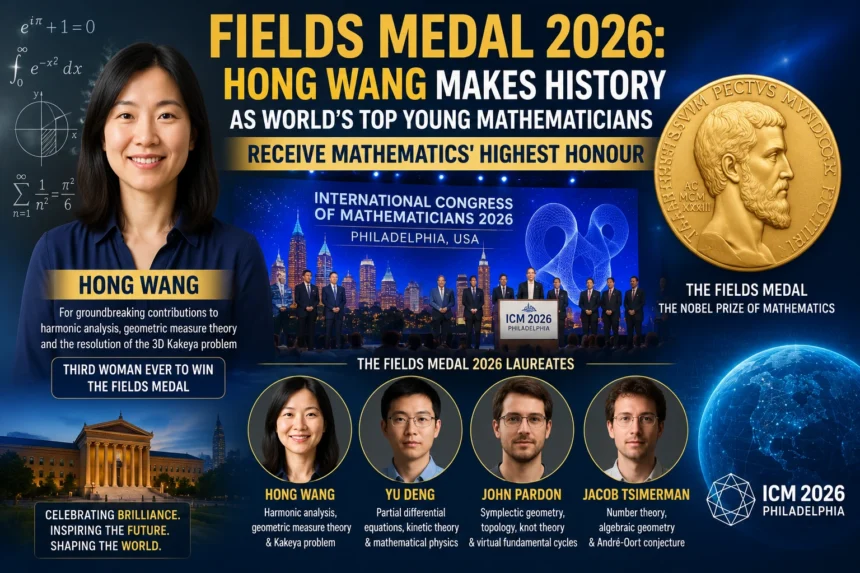
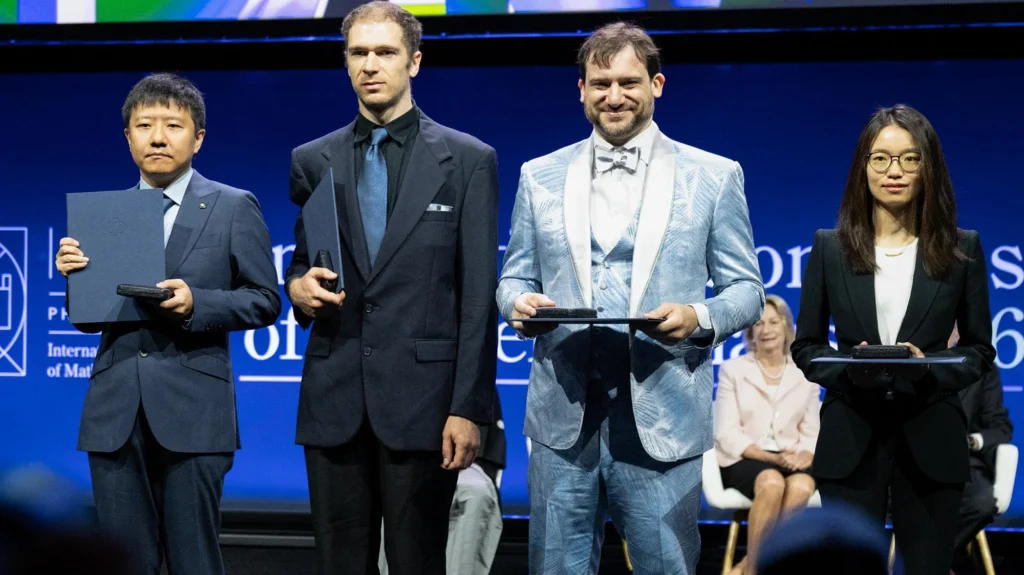
The global mathematics community celebrated one of its most prestigious moments as the 2026 Fields Medals were presented during the International Congress of Mathematicians (ICM) in Philadelphia, USA. Among this year’s four recipients, Hong Wang created history by becoming only the third woman ever to receive the Fields Medal in the award’s 90-year history. Her groundbreaking work in harmonic analysis and geometric measure theory, including major advances on the famous Kakeya problem, has been hailed as one of the most significant mathematical achievements of the decade.
Often referred to as the “Nobel Prize of Mathematics,” the Fields Medal is awarded once every four years by the International Mathematical Union (IMU) to mathematicians under the age of 40 whose research has transformed the discipline and shows exceptional promise for future discoveries. (International Mathematical Union)
A Historic Achievement for Hong Wang
Hong Wang, a professor at New York University (NYU) and the Institut des Hautes Études Scientifiques (IHES) in France, has become the third female mathematician ever to receive the Fields Medal after Maryam Mirzakhani (2014) and June Huh’s era still male? (Correction: Maryna Viazovska became the second woman in 2022; Hong Wang is the third in 2026.) Her achievement is also historic because she is among the first Chinese nationals to receive the Fields Medal. (Live Science)
The IMU recognized Wang for her pioneering contributions to:
- Harmonic analysis
- Geometric measure theory
- Fourier restriction theory
- Falconer distance problems
- Furstenberg sets
- The three-dimensional Kakeya problem
Her work has significantly advanced mathematicians’ understanding of geometric structures and wave propagation, with implications extending beyond pure mathematics into physics, signal processing, and engineering. (International Mathematical Union)
Solving the Kakeya Problem
One of Hong Wang’s most celebrated accomplishments was her collaboration with mathematician Joshua Zahl on the three-dimensional Kakeya conjecture.
Originally proposed by Japanese mathematician Sōichi Kakeya more than a century ago, the Kakeya problem asks how small a geometric set can be while still allowing a line segment to rotate through every possible direction.
Although deceptively simple in appearance, the problem became one of modern mathematics’ most difficult challenges.
Wang and Zahl developed an innovative proof that resolved the three-dimensional version of this problem, a breakthrough widely regarded as a landmark achievement in harmonic analysis and geometric measure theory. Experts have described the work as a “once-in-a-generation” mathematical accomplishment. (Live Science)
The Four Fields Medal Winners of 2026
The International Mathematical Union awarded the 2026 Fields Medals to four outstanding young mathematicians:

Hong Wang
Recognized for groundbreaking contributions to harmonic analysis and the Kakeya problem.
Yu Deng
Honoured for major advances in partial differential equations, kinetic theory, and mathematical physics.
John Pardon
Awarded for pioneering work in symplectic geometry, topology, knot theory, and virtual fundamental cycles.
Jacob Tsimerman
Recognized for revolutionary contributions to number theory, algebraic geometry, and the André-Oort conjecture. (International Mathematical Union)
Why the Fields Medal Is So Prestigious
Established in 1936, the Fields Medal is awarded every four years during the International Congress of Mathematicians.
Unlike the Nobel Prize, recipients must be under 40 years of age, emphasizing both exceptional achievement and future research potential.
The award includes:
- A gold medal
- A cash prize
- Worldwide recognition
- Membership among the greatest mathematicians of modern history
Winning the Fields Medal often transforms a mathematician into an international scientific leader whose work influences generations of researchers. (International Mathematical Union)
Why Hong Wang’s Win Matters
Hong Wang’s success represents an important milestone for women in mathematics.
For decades, mathematics has remained one of the most male-dominated scientific disciplines. With Wang becoming only the third female recipient in nearly ninety years, her achievement symbolizes increasing opportunities and recognition for women pursuing advanced mathematical research.
Her accomplishment is also expected to inspire young researchers, particularly women and students from Asia, to pursue careers in pure mathematics and theoretical sciences. (Live Science)
A Landmark for Chinese Mathematics
The 2026 awards also marked another historic first.
For the first time, two Chinese nationals—Hong Wang and Yu Deng—received the Fields Medal in the same year, highlighting China’s growing influence in global mathematical research.
Both mathematicians have built internationally recognized careers while contributing to leading universities and research institutions worldwide. Their success reflects decades of investment in higher education, international collaboration, and scientific research. (The Wall Street Journal)
International Recognition
The announcement generated congratulations from universities, research institutes, and scientific organizations around the world.
New York University, IHES, École Polytechnique, and several international mathematical societies praised Wang’s originality and lasting contributions to mathematics.
Researchers described her work as technically brilliant while also opening entirely new directions for future mathematical research. (École polytechnique, école d’ingénieur)
Broader Impact Beyond Mathematics
Although Fields Medal research often appears highly theoretical, its long-term influence extends into numerous scientific and technological fields.
Research in harmonic analysis and geometry contributes to advances in:
- Artificial intelligence
- Data science
- Signal processing
- Medical imaging
- Quantum computing
- Telecommunications
- Computer vision
- Cryptography
Many mathematical discoveries that initially seemed abstract later became the foundation of modern technologies.
The International Congress of Mathematicians
The International Congress of Mathematicians (ICM) is the world’s largest gathering of mathematicians and is held every four years.
The 2026 Congress in Philadelphia brought together thousands of researchers, educators, and students from across the globe.
Besides the Fields Medals, the Congress serves as a platform for presenting cutting-edge discoveries that shape the future of mathematics and its applications across science and technology. (Scientific American)
Looking Ahead
Hong Wang’s achievement is expected to influence mathematical research for decades. Her innovative methods have already inspired new work in harmonic analysis, geometric measure theory, and related disciplines.
Meanwhile, the recognition of all four 2026 Fields Medalists highlights the remarkable diversity of modern mathematical research—from fluid dynamics and topology to number theory and geometry—demonstrating how fundamental mathematics continues to drive scientific progress.
Conclusion
The 2026 Fields Medals represent one of the most significant celebrations of mathematical excellence in recent years. Hong Wang’s historic recognition as only the third woman to receive the award—and one of the first Chinese nationals to do so—marks a defining moment in the history of mathematics. Together with fellow laureates Yu Deng, John Pardon, and Jacob Tsimerman, she represents a new generation of researchers whose discoveries will shape the future of science, technology, and human knowledge for decades to come.