

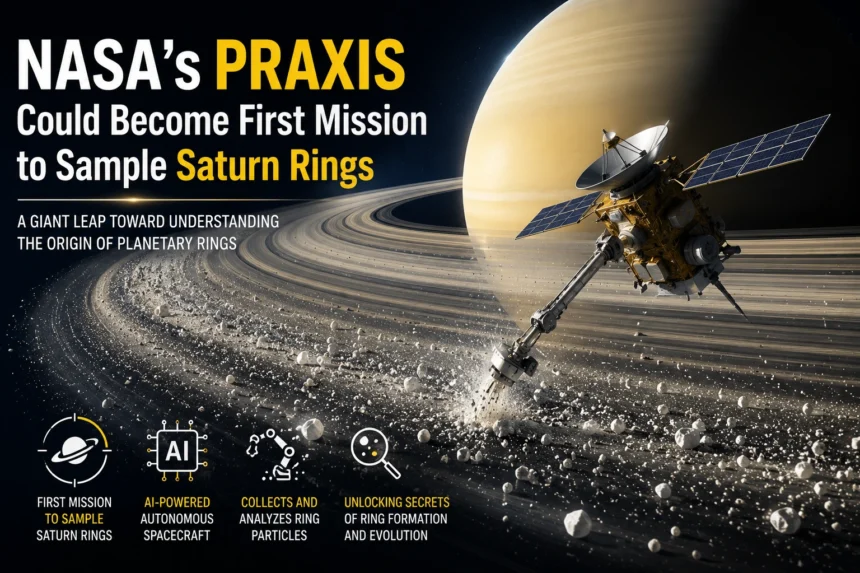
PRAXIS: NASA’s Ambitious Mission to Graze and Sample Saturn’s Planetary Rings
Science & Space | PaperPatrika Special Report
For centuries, the majestic rings of Saturn have fascinated astronomers and inspired countless scientific theories. Despite decades of exploration—including NASA’s groundbreaking Cassini mission—no spacecraft has ever physically touched or collected material directly from a planetary ring. That could change with PRAXIS (Planetary Rings Autonomous EXploration with In-situ Sampling), a newly selected concept under NASA’s Innovative Advanced Concepts (NIAC) program.
Developed by Marco Quadrelli and his team at NASA’s Jet Propulsion Laboratory (JPL), PRAXIS is not yet an approved flight mission. Instead, it is an advanced technology concept that aims to demonstrate how an autonomous spacecraft could safely approach, sample, and analyze particles from Saturn’s rings—something never attempted before. If the concept eventually matures into a full mission, it could revolutionize scientists’ understanding of how planetary rings formed, evolved, and continue to change today. (NASA)
A New Chapter in Ring Exploration
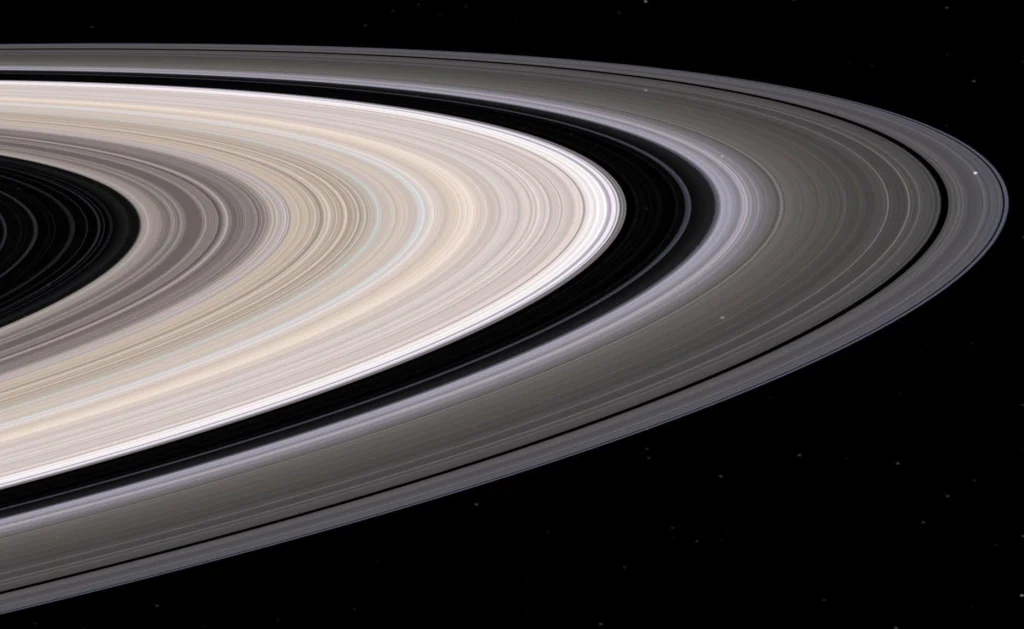
Planetary rings are among the most dynamic environments in the Solar System. Saturn’s spectacular rings consist mainly of water-ice particles ranging from microscopic dust grains to chunks as large as houses. These particles constantly collide, merge, and separate while orbiting the giant planet at tremendous speeds.
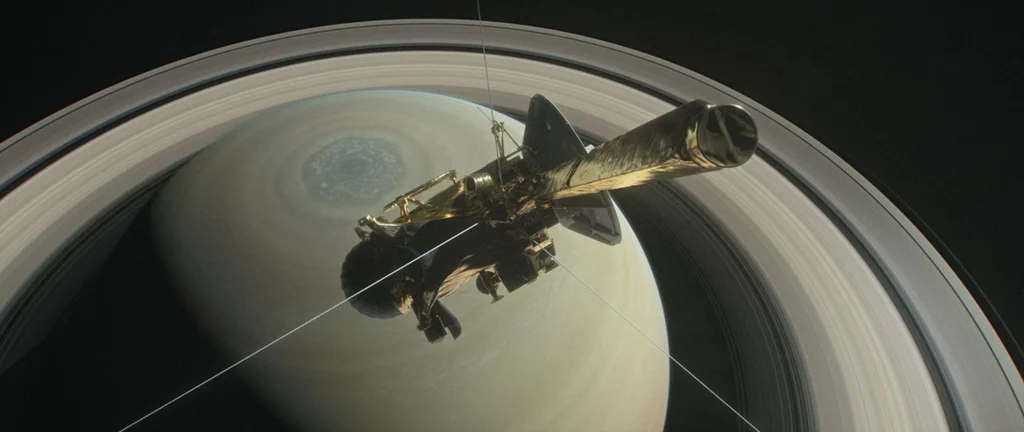
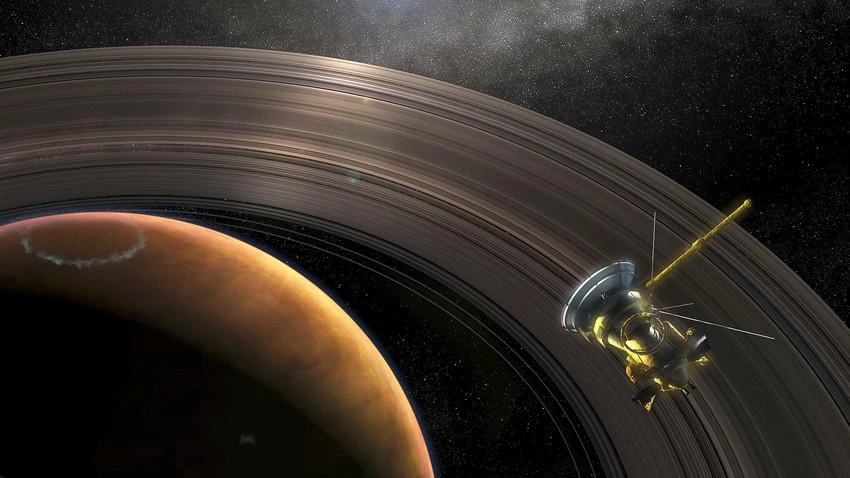
Although NASA’s Cassini spacecraft spent more than 13 years studying Saturn and even executed daring “ring-grazing” orbits during the final phase of its mission, it was never designed to collect physical samples from the rings themselves. Cassini provided extraordinary images and remote measurements but left many key scientific questions unanswered. (NASA Science)
PRAXIS seeks to bridge that gap by taking the unprecedented step of directly sampling ring particles.
What Exactly is PRAXIS?
PRAXIS stands for Planetary Rings Autonomous EXploration with In-situ Sampling. Selected as a 2026 NIAC Phase I study, the concept focuses on developing an intelligent robotic system capable of safely navigating the hazardous environment surrounding Saturn’s rings.
Unlike conventional spacecraft that simply observe from a distance, PRAXIS would use artificial intelligence, advanced robotic autonomy, and precision guidance systems to identify suitable ring particles, approach them carefully, collect samples, and analyze them onboard. (NASA)
Why Sampling Saturn’s Rings Matters
Scientists still debate several fundamental questions about Saturn’s rings:
- How old are the rings?
- Did they form alongside Saturn or much later?
- Are they remnants of shattered moons or ancient comets?
- How do particles continuously collide without completely dispersing?
- What role do gravity and nearby moons play in shaping ring structures?
Direct analysis of ring particles could provide chemical and physical evidence unavailable through telescopes or remote sensing alone.
Researchers hope measurements of particle size, porosity, composition, and internal structure could transform understanding not only of Saturn’s rings but also of the early Solar System, where protoplanetary disks once surrounded the young Sun. (NASA)
AI at the Heart of the Mission
One of PRAXIS’s most innovative features is its reliance on artificial intelligence.
Because Saturn’s ring particles move continuously and unpredictably, real-time decision-making would be essential. Communication delays between Earth and Saturn—often more than an hour round-trip—make remote piloting impractical.
Instead, PRAXIS would autonomously:
- Detect suitable target particles.
- Predict their trajectories.
- Avoid dangerous collisions.
- Position the spacecraft safely.
- Execute precision sampling.
- Analyze collected material in real time.
NASA says the mission concept adapts technologies inspired by sport casting and combines them with autonomous robotics to capture free-floating particles. (NASA)
The “Touch-and-Go” Sampling Strategy
Rather than flying directly through dense ring material, PRAXIS proposes a safer approach.
After identifying a target particle, the spacecraft would remain at a relatively safe distance while extending a long, soft deployable boom. This boom would briefly touch the particle’s surface in a carefully controlled “touch-and-go” maneuver before retracting with collected material.
Once sampling is complete, the spacecraft would move to another region or gap within the rings to repeat the process, enabling scientists to compare particles from different environments. (NASA)
Building on Cassini’s Legacy
NASA’s Cassini mission fundamentally changed our understanding of Saturn between 2004 and 2017.
Its final “Grand Finale” included multiple ring-grazing orbits that passed just outside the main rings, allowing instruments to sample nearby dust and gases. However, Cassini was never intended to land on or physically collect ring particles.
PRAXIS builds directly on those discoveries, aiming to perform the kind of close-contact exploration that Cassini could only hint at. (NASA Science)
More Than Just Saturn
Although Saturn is the primary target, the technologies developed through PRAXIS could have much broader applications.
NASA notes that similar robotic sampling systems could eventually explore:
- Uranus’ faint rings.
- Neptune’s ring system.
- Ringed minor planets such as Chariklo and Chiron.
- Dust disks surrounding newly forming stars.
Such versatility makes PRAXIS valuable not only as a Saturn mission concept but also as a technology platform for future planetary exploration. (NASA)
Current Mission Status
It is important to understand that PRAXIS has not yet been approved as a full NASA mission.
The concept has been selected under NASA’s NIAC Phase I program, which funds early-stage visionary ideas considered potentially transformative but still requiring technical validation.
During Phase I, engineers will:
- Conduct detailed simulations.
- Develop spacecraft system designs.
- Test autonomous navigation concepts.
- Evaluate sampling technologies.
- Assess overall mission feasibility.
Successful completion could lead to further development in Phase II and eventually consideration for a future planetary mission. (NASA)
Scientific Importance
Planetary scientists consider ring systems natural laboratories for studying processes that shaped planets billions of years ago.
Understanding how ring particles interact can also improve models of:
- Planet formation.
- Moon formation.
- Dust disk evolution.
- Gravitational interactions.
- Collision physics.
The knowledge gained from PRAXIS could therefore extend well beyond Saturn, influencing theories about planetary systems across the universe.
Engineering Challenges
Sampling particles traveling at enormous orbital speeds presents formidable engineering obstacles.
The spacecraft must:
- Navigate safely among constantly moving debris.
- Avoid collisions with larger ice blocks.
- Maintain precise positioning.
- Operate autonomously for extended periods.
- Protect sensitive scientific instruments.
These challenges explain why no previous mission has attempted such direct sampling.
Looking Ahead
If PRAXIS eventually becomes an operational mission, it would represent one of the boldest robotic exploration projects ever attempted.
By combining artificial intelligence, autonomous robotics, and precision sampling technologies, NASA hopes to move beyond observation and into direct interaction with one of the Solar System’s most iconic structures.
While the project remains in its early conceptual stage, its selection under the NIAC program reflects growing confidence that futuristic technologies once considered impossible may soon become achievable.
Conclusion
PRAXIS is more than just another mission proposal—it represents a bold vision for the future of planetary exploration. By attempting the first direct collection and analysis of Saturn’s ring particles, the concept has the potential to answer decades-old scientific questions while pioneering technologies that could transform exploration across the Solar System.
Although still in the research and development phase, PRAXIS demonstrates NASA’s commitment to pursuing ambitious ideas that push the boundaries of engineering and science. If the mission ultimately flies, humanity may soon witness the first spacecraft to truly “touch” the rings of a planet, opening an entirely new chapter in our exploration of the cosmos.