

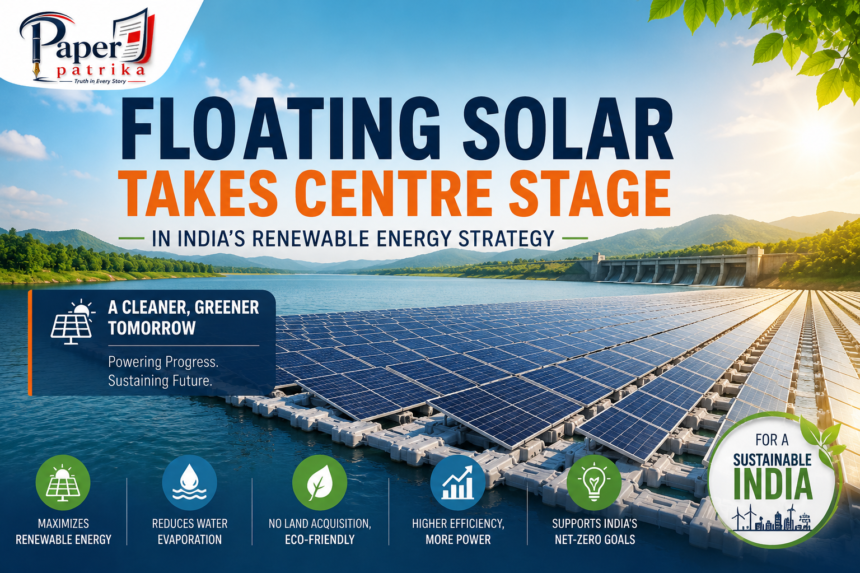
Future of Floating Solar in India’s Renewable Energy Strategy.
By PaperPatrika | Energy & Environment | August 2026
India’s transition toward clean energy has received a significant boost with the Union Cabinet approving the Pradhan Mantri Surya Sarovar Yojana (PM-SSY), a ₹5,070 crore initiative aimed at expanding Floating Solar Photovoltaic (FSPV) projects across the country. The ambitious scheme targets increasing India’s floating solar capacity from around 700 MW to 5,000 MW, making it one of the largest government-backed floating solar programs globally. (The Economic Times)
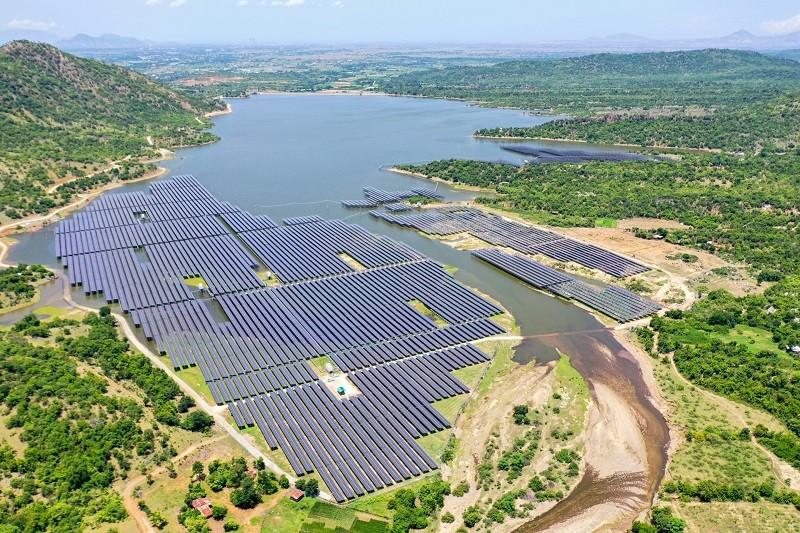
The announcement comes at a time when India is facing growing challenges related to land acquisition for renewable energy projects. Floating solar plants, installed on reservoirs, lakes, dams, and other water bodies, are increasingly being viewed as an innovative solution capable of meeting India’s rising electricity demand without competing for valuable agricultural or urban land.
A New Chapter in India’s Renewable Energy Journey
India has already emerged as one of the world’s fastest-growing renewable energy markets. However, as utility-scale solar parks expand, finding large parcels of suitable land has become increasingly difficult.
Floating Solar PV addresses this challenge by utilizing unused water surfaces instead of land. According to the Ministry of New and Renewable Energy (MNRE), India possesses more than 102 GW of deployable floating solar potential, enough to substantially increase the nation’s renewable energy capacity. (Press Information Bureau)
To accelerate deployment, the government has also launched a Floating Solar Potential Map and is working on a dedicated policy framework to support project implementation nationwide. (Ministry of New and Renewable Energy)
What is Floating Solar?
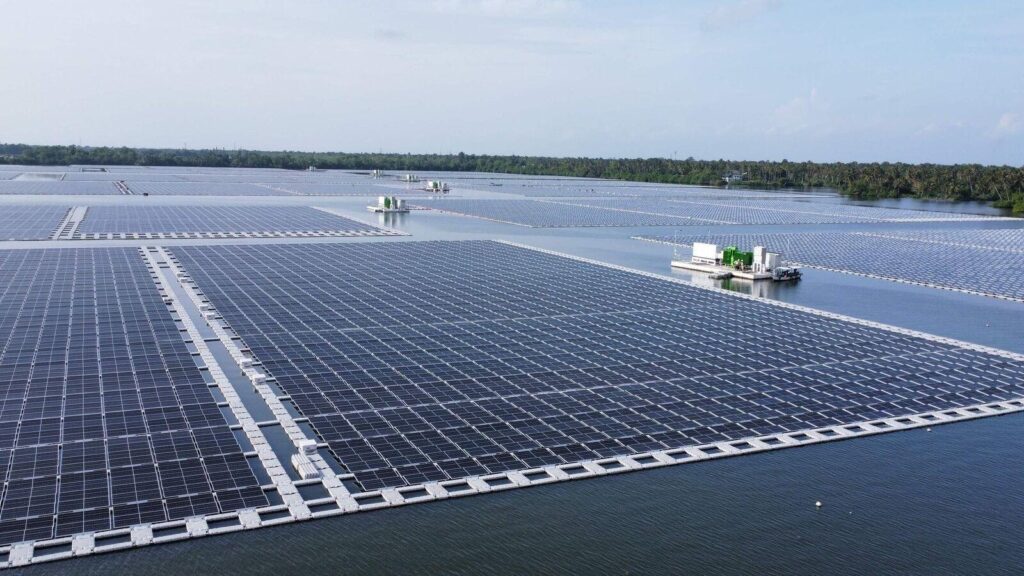
Floating Solar Photovoltaic (FSPV) systems consist of conventional solar panels mounted on specially designed floating structures anchored on lakes, reservoirs, irrigation ponds, and hydropower dams.
Unlike traditional solar farms that require extensive land, floating solar installations occupy only a portion of a water body’s surface, allowing existing water infrastructure to serve multiple purposes simultaneously.
This technology has already been adopted successfully in countries including China, Singapore, Japan, South Korea, and the Netherlands.
Why Floating Solar Matters for India
1. Solving the Land Challenge
One of India’s biggest barriers to expanding solar capacity is land acquisition.
Large-scale ground-mounted solar projects often require thousands of acres, leading to delays, environmental concerns, and conflicts over agricultural land.
Floating solar eliminates much of this challenge by utilizing existing reservoirs and water bodies.
2. Higher Energy Efficiency
Solar panels naturally lose efficiency when temperatures rise.
Water beneath floating panels provides a cooling effect, allowing panels to operate at lower temperatures and generate around 5% more electricity under Indian conditions than comparable ground-mounted systems. (REGlobal)
3. Reduced Water Evaporation
Floating panels partially shade reservoirs, reducing evaporation losses.
This benefit is particularly valuable for water-scarce regions where reservoirs are used for irrigation and drinking water.
4. Better Use of Existing Infrastructure
Many reservoirs already have transmission lines nearby because they are associated with hydroelectric plants.
This reduces infrastructure costs while making integration into the power grid easier.
Government’s ₹5,070 Crore Push
Under the newly approved PM-Surya Sarovar Yojana, the government plans to:
- Develop 5,000 MW of floating solar capacity.
- Integrate Battery Energy Storage Systems (BESS) with at least two hours of backup.
- Promote renewable energy without additional land acquisition.
- Strengthen India’s energy security while reducing carbon emissions. (The Economic Times)
Industry experts believe this scheme could significantly accelerate commercial adoption over the next few years.
Which States Have the Highest Potential?
According to the National Institute of Solar Energy (NISE), the leading states for floating solar potential include:
| State | Estimated Potential |
| Maharashtra | 16.3 GW |
| Madhya Pradesh | 14.9 GW |
| Karnataka | 13.7 GW |
Many additional opportunities exist across Telangana, Andhra Pradesh, Gujarat, Odisha, Kerala, and Tamil Nadu. (The Times of India)
Challenges Still Remain
Despite its enormous promise, floating solar faces several technical and financial challenges.
Higher Installation Costs
Floating structures, anchoring systems, and specialized electrical equipment increase project costs compared to conventional solar farms.
Maintenance Requirements
Water exposure can accelerate equipment corrosion.
Regular inspections, cleaning, and specialized maintenance are required.
Environmental Considerations
Projects must ensure they do not negatively impact aquatic ecosystems, fisheries, or biodiversity.
Proper environmental assessments remain essential before large-scale deployment.
Extreme Weather Risks
Heavy rainfall, cyclones, and fluctuating reservoir water levels can create engineering challenges that require robust floating platforms and anchoring systems.
Industry Outlook
Market analysts believe floating solar represents one of India’s largest untapped renewable opportunities.
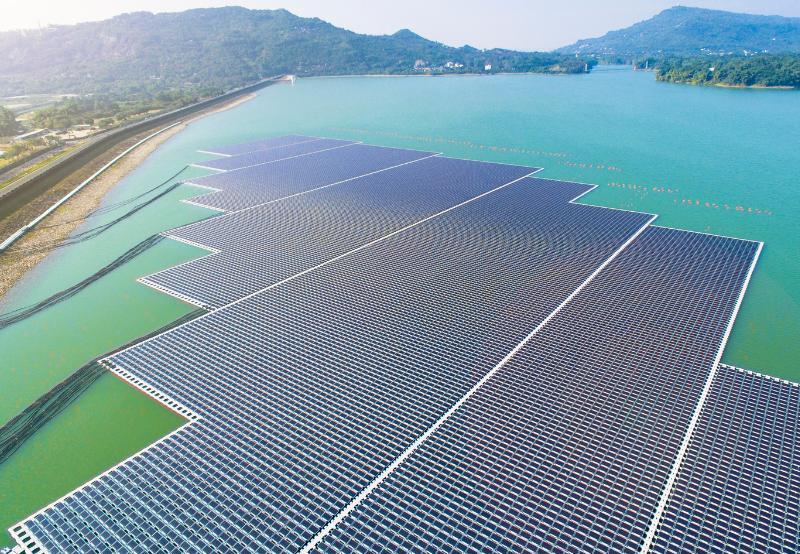
Recent research indicates that India has already crossed 1 GW in its floating solar project pipeline, although only a fraction of its estimated 102 GW potential has been developed so far. (Mercomindia.com)
Academic studies also suggest that floating solar can become economically competitive through targeted financial incentives, optimized reservoir selection, and supportive government policies. (ScienceDirect)
Global Momentum
Countries across Asia and Europe are rapidly investing in floating solar.
Singapore continues expanding floating solar despite engineering challenges associated with marine environments, while the Netherlands has demonstrated that floating solar farms can even create new habitats for aquatic species under certain conditions. (The Times of India)
These international experiences provide valuable lessons for India’s future deployments.
Conclusion
Floating solar is no longer just an emerging technology—it is becoming a strategic pillar of India’s clean energy transition.
With the launch of PM-Surya Sarovar Yojana, strong policy support, and an estimated 102 GW of untapped potential, India has an opportunity to overcome land constraints while accelerating renewable energy generation.
Although challenges such as higher installation costs and maintenance remain, advancements in technology, improved financing, and supportive government policies could make floating solar a major contributor to India’s goal of achieving a cleaner, more sustainable energy future.
If implemented successfully, floating solar may become one of the defining innovations powering India’s journey toward net-zero emissions and long-term energy security.