

New Delhi | Business Desk
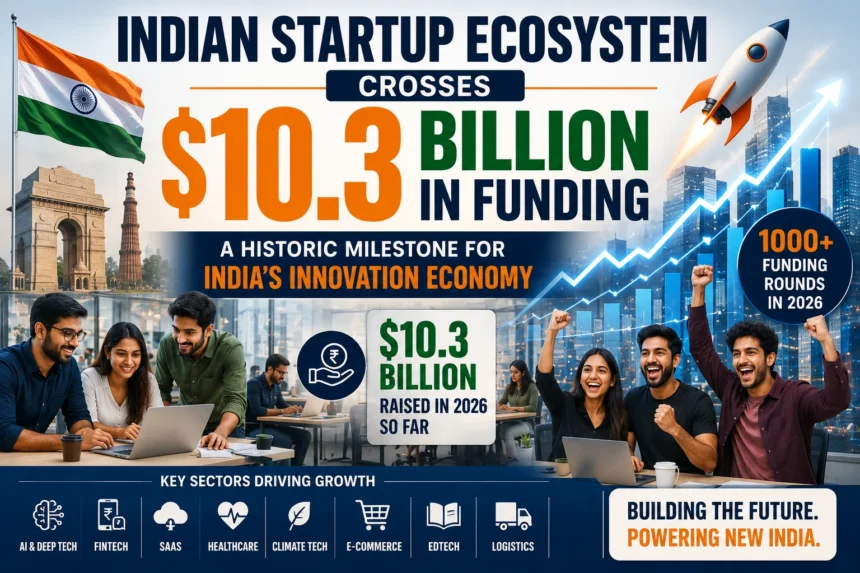
India’s startup ecosystem has achieved another remarkable milestone in 2026, with total startup funding crossing $10.3 billion during the year so far. According to startup market intelligence reports, the funding has been raised across more than 1,000 investment rounds, reflecting sustained investor confidence in India’s rapidly expanding technology and innovation ecosystem. The achievement reinforces India’s status as the third-largest startup ecosystem in the world, behind only the United States and China. (Tracxn)
Despite a more disciplined global venture capital environment compared with the funding boom of 2021, investors continue to view India as one of the most attractive long-term markets for technology innovation. Artificial Intelligence (AI), fintech, Software-as-a-Service (SaaS), deep technology, climate technology, healthcare, logistics, and manufacturing startups have emerged as the biggest beneficiaries of this investment wave.
Industry experts believe the latest funding milestone reflects not only growing investor confidence but also the increasing maturity of Indian startups, many of which are now focused on profitability, sustainable growth, and global expansion rather than rapid cash-driven expansion.
A Record Year for Indian Startups
According to startup ecosystem data, Indian companies have collectively secured over $10.3 billion in venture capital funding during 2026. More than 1,000 funding rounds have been completed, ranging from seed-stage investments to late-stage financing and pre-IPO rounds. (Tracxn)
Unlike previous years, investors are concentrating larger amounts of capital into startups with proven business models, strong governance, and clear revenue growth. This shift has resulted in fewer speculative investments and greater emphasis on long-term value creation.
Why Investors Are Backing India
Several structural factors continue to attract domestic and international investors.

1. Large Consumer Market
India has a population of more than 1.4 billion people, making it one of the world’s largest consumer markets.
Growing smartphone adoption, affordable internet access, rising digital payments, and expanding middle-class purchasing power provide startups with enormous opportunities.
2. Digital Transformation
India’s digital economy has expanded rapidly through initiatives such as:
- UPI Digital Payments
- Aadhaar Digital Identity
- ONDC
- Digital India
- IndiaAI Mission
These programs have created an environment where technology startups can scale rapidly.
3. Government Support
Government initiatives continue encouraging entrepreneurship through:
- Startup India
- Make in India
- Atmanirbhar Bharat
- Production Linked Incentive (PLI)
- National Semiconductor Mission
These policies have improved access to funding, infrastructure, and global markets.
Which Sectors Attracted the Most Funding?
Investment activity in 2026 has been concentrated in several high-growth industries.
Artificial Intelligence (AI)
AI remains India’s fastest-growing startup sector.
Companies are developing solutions in:
- Enterprise AI
- Generative AI
- Healthcare AI
- Financial AI
- Industrial Automation
- Customer Service
AI startups attracted some of the largest investment rounds of the year.
FinTech
India’s fintech sector continues expanding rapidly.
Popular investment areas include:
- Digital Lending
- Wealth Management
- Insurance Technology
- Digital Payments
- SME Financing
The widespread adoption of UPI has strengthened India’s fintech ecosystem.
Software-as-a-Service (SaaS)
Indian SaaS companies now serve customers across North America, Europe, and Asia.
Their recurring subscription revenue models make them highly attractive to venture capital investors.
Climate Technology
Investors are increasingly funding startups focused on:
- Electric Vehicles
- Battery Technology
- Renewable Energy
- Carbon Reduction
- Sustainable Manufacturing
Climate-tech is expected to remain one of the fastest-growing investment sectors over the next decade.
Deep Technology
Deep-tech startups working in robotics, semiconductors, cybersecurity, aerospace, and defence technology have attracted increasing investor interest.
India is gradually building expertise in high-value research and engineering sectors.
Bengaluru Continues to Lead
Bengaluru remains India’s startup capital.

The city hosts thousands of startups across AI, software, fintech, biotech, and enterprise technology.
Other major startup hubs include:
- Delhi-NCR
- Mumbai
- Hyderabad
- Chennai
- Pune
These cities continue attracting entrepreneurs, venture capital firms, incubators, and multinational technology companies.
Rise of Unicorns
India remains home to one of the world’s largest populations of unicorn startups.
A unicorn is a privately held startup valued at more than $1 billion.
The country now has dozens of unicorns operating across:
- E-commerce
- FinTech
- SaaS
- Logistics
- Education Technology
- Healthcare
Many of these companies are preparing for stock market listings in the coming years.
International Investors Show Confidence
Global investment firms continue increasing their exposure to India.
Major investors include:
- Accel
- Peak XV Partners
- Lightspeed Venture Partners
- SoftBank
- Tiger Global
- General Catalyst
- Prosus Ventures
International investors increasingly consider India one of the world’s most important long-term technology markets.
Startups Focus on Profitability
Unlike the aggressive expansion strategies seen during the pandemic-era funding boom, today’s startups are emphasizing:
- Positive cash flow
- Sustainable revenue
- Operational efficiency
- Better corporate governance
- Long-term profitability
Investors now prioritize business fundamentals over rapid user acquisition.
Economic Impact
India’s startup ecosystem plays an increasingly important role in national economic development.
Growing investment is expected to contribute to:
- Job creation
- Technology exports
- Research and development
- Manufacturing expansion
- Tax revenue
- Digital innovation
The startup ecosystem has become an important driver of India’s ambition to become a $5 trillion economy.
Challenges Facing Indian Startups
Despite strong funding momentum, startups continue facing several challenges.
These include:
- Global economic uncertainty.
- Rising competition.
- Regulatory compliance.
- Talent shortages in specialized fields.
- Pressure to achieve profitability.
Nevertheless, analysts believe India’s long-term growth prospects remain strong.
Global Position of India
India is widely recognized as the third-largest startup ecosystem globally.
Its strengths include:
- Large engineering talent pool.
- Growing domestic market.
- Strong digital infrastructure.
- Increasing venture capital availability.
- Supportive government policies.
Many multinational companies are also establishing innovation and research centers in India.
Future Outlook
Experts expect investment activity to remain healthy throughout the rest of 2026.
Future funding is likely to focus on:
- Artificial Intelligence
- Robotics
- Semiconductor Design
- Space Technology
- Defence Technology
- Healthcare Innovation
- Climate Technology
As India strengthens its innovation ecosystem, startups are expected to expand further into international markets.
Why This Milestone Matters
Crossing $10.3 billion in startup funding demonstrates that India’s innovation ecosystem has moved beyond its early growth phase.
The ecosystem now attracts:
- Global venture capital.
- Institutional investors.
- Sovereign wealth funds.
- Corporate investors.
This growing confidence reflects India’s emergence as one of the world’s leading destinations for entrepreneurship and technology innovation.
Conclusion
India’s startup ecosystem crossing $10.3 billion in funding during 2026 marks another major achievement in the country’s innovation journey. The milestone reflects increasing investor confidence, stronger business fundamentals, and the rapid growth of sectors such as Artificial Intelligence, fintech, SaaS, climate technology, and deep technology.
While challenges remain, India’s combination of entrepreneurial talent, supportive government policies, expanding digital infrastructure, and a large consumer market positions it for sustained growth. As startups increasingly focus on profitability and global expansion, India is well placed to strengthen its role as one of the world’s most influential technology and innovation hubs in the years ahead. (Tracxn)
Read More:- India’s Late-Stage Start-up Funding Sees Bigger Deals: A New Growth Phase for the Indian Start-up Ecosystem
Europe’s Helsing Becomes an $18 Billion Defence AI Start-up: A New Era for European Military Innovation.