

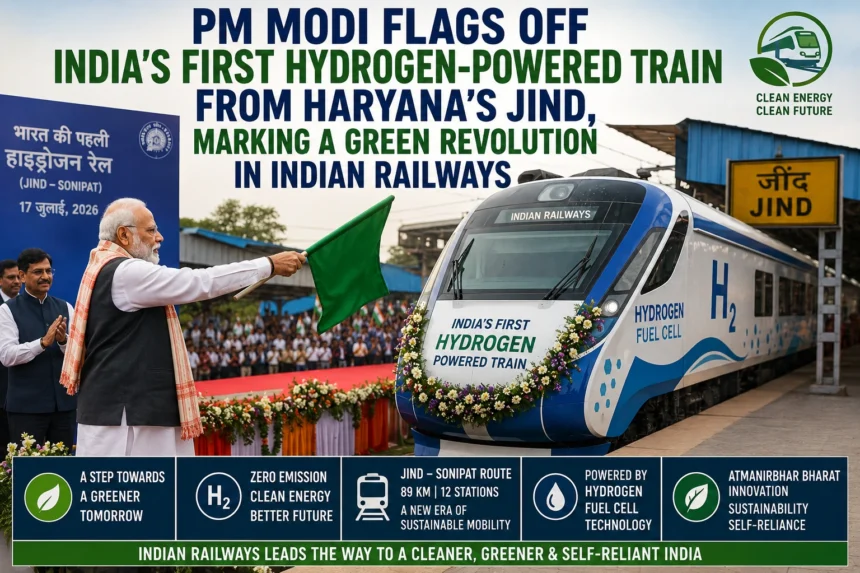
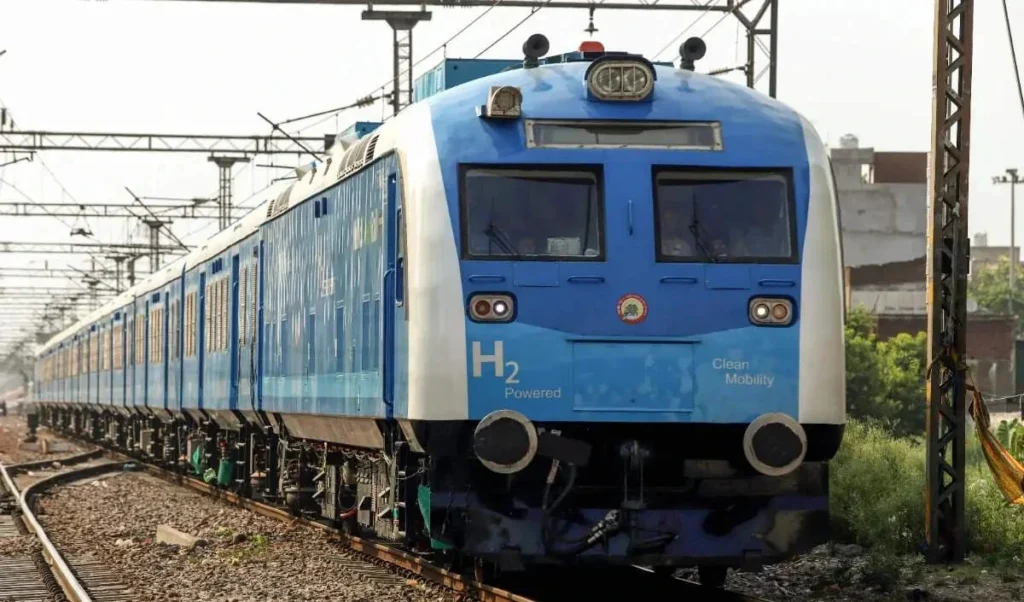
India achieved a major milestone in sustainable transportation on July 17, 2026, when Prime Minister Narendra Modi flagged off the country’s first hydrogen-powered passenger train from Jind railway station in Haryana. The launch marks India’s entry into an exclusive group of nations operating hydrogen-powered rail services and reflects the government’s growing emphasis on clean energy, indigenous technology, and environmentally friendly public transport.
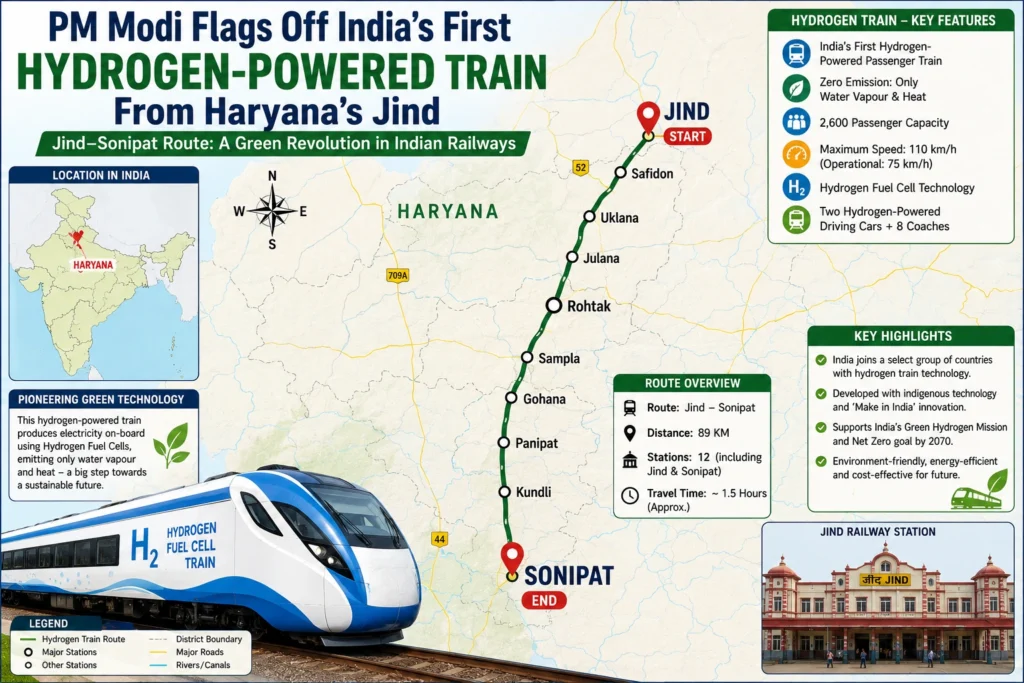
The train will operate on the 89-kilometre Jind–Sonipat route, replacing conventional fossil-fuel dependence with an advanced hydrogen fuel-cell propulsion system that emits only water vapour and heat, making it one of the cleanest forms of rail transportation available today.
A Historic Day for Indian Railways
The inauguration ceremony at Jind Railway Station was attended by Railway Minister Ashwini Vaishnaw, Haryana Governor Ashim Kumar Ghosh, Haryana Chief Minister Nayab Singh Saini, senior railway officials, engineers, school students, and thousands of local residents.
As Prime Minister Modi waved the green flag, the train departed amid applause, symbolising the beginning of a new chapter in India’s railway history. During his address, the Prime Minister described the project as a major step toward achieving energy security, technological self-reliance, and sustainable development. (ThePrint)
India’s Entry into the Global Hydrogen Rail Club
With the launch of this train, India has joined a select group of countries—including Germany, France, China, Italy, and South Korea—that have introduced hydrogen-powered passenger trains.
The project demonstrates India’s growing capabilities in clean transportation technologies and supports the country’s broader commitment to achieving net-zero carbon emissions by 2070. (Reuters)
What Makes the Hydrogen Train Special?
Unlike conventional diesel trains or electric trains that depend on overhead power lines, the hydrogen-powered train generates electricity onboard through hydrogen fuel cells.
Inside the fuel cell, hydrogen reacts with oxygen from the atmosphere to produce electricity, which powers the train’s motors. The only direct by-products are water vapour and heat, eliminating harmful emissions such as carbon dioxide, sulphur oxides, and particulate matter. (The Indian Express)
This makes hydrogen trains particularly suitable for routes where electrification is difficult or expensive.
Key Technical Features
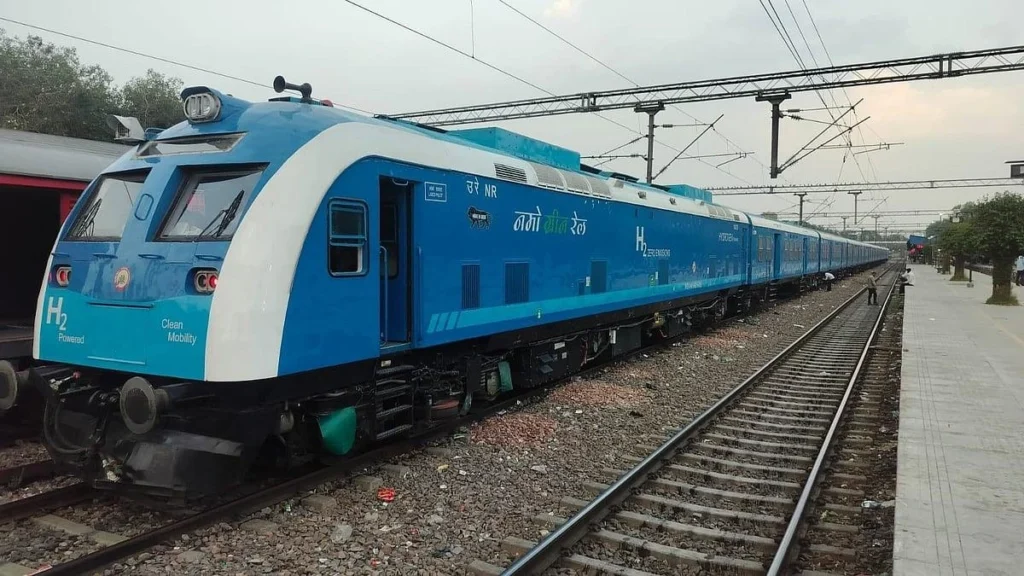
India’s first hydrogen train has been designed and developed using indigenous technology and includes several advanced features:
- Two hydrogen-powered driving cars.
- Eight passenger coaches.
- Around 2,600 passenger capacity.
- Maximum design speed of 110 km/h.
- Operational speed of 75 km/h on the Jind–Sonipat section.
- Combined power output of approximately 2,400 kW.
- One of the world’s longest hydrogen-powered passenger trainsets. (The Times of India)
Multi-Layer Safety Systems
Hydrogen is highly combustible, making safety a critical aspect of the project.
Indian Railways has equipped the train with multiple safety mechanisms, including:
- Hydrogen leak detection sensors.
- Smoke detection systems.
- Flame monitoring.
- Heat sensors.
- Automatic emergency shutdown mechanisms.
- Continuous onboard monitoring systems.
Railway officials stated that the train underwent extensive testing before receiving operational clearance. (Press Information Bureau)
India’s Largest Hydrogen Refuelling Facility
To support operations, Indian Railways has established the country’s largest hydrogen storage and refuelling facility at Jind.
The infrastructure enables rapid hydrogen refilling while maintaining strict international safety standards.
The facility also serves as a demonstration project for future hydrogen-based railway operations across India. (The Times of India)
Why the Jind–Sonipat Route Was Chosen
Railway authorities selected the Jind–Sonipat route after evaluating several operational parameters.
The corridor offers:
- Moderate passenger traffic.
- Suitable track conditions.
- Limited operational complexity.
- Easy monitoring during the initial deployment.
- Efficient maintenance access.
The route covers approximately 89 kilometres and includes 12 intermediate stations, making it an ideal pilot corridor for hydrogen technology. (The Times of India)
Developed with Indigenous Technology
One of the most significant aspects of the project is that the train has been designed, engineered, and integrated in India.
Major contributors include:
- Research Designs and Standards Organisation (RDSO).
- Integral Coach Factory (ICF), Chennai.
- Medha Servo Drives.
- Indian Railways engineers.
Officials described the project as a successful example of the Make in India initiative and indigenous railway innovation. (The Times of India)
Supporting India’s Green Hydrogen Mission
The hydrogen train aligns closely with the National Green Hydrogen Mission, which seeks to position India as a global hub for hydrogen production and utilization.
The railway sector is among the country’s largest consumers of energy. Introducing hydrogen technology could significantly reduce dependence on imported fossil fuels while supporting India’s transition to cleaner energy systems. (AP News)
Environmental Benefits
Compared with diesel locomotives, hydrogen-powered trains offer several environmental advantages:
- Zero carbon emissions at the point of operation.
- Water vapour as the only exhaust.
- Reduced air pollution.
- Lower greenhouse gas emissions.
- Quieter operation.
- Improved energy efficiency on non-electrified routes.
These benefits make hydrogen technology an attractive option for sustainable rail transport, especially where full electrification is impractical. (The Indian Express)
Economic and Industrial Impact
The launch is expected to stimulate India’s emerging hydrogen economy.
Experts believe the project will encourage investment in:
- Hydrogen production.
- Fuel-cell manufacturing.
- Railway engineering.
- Clean-energy infrastructure.
- Advanced transportation technologies.
It also strengthens India’s ambitions to become a global exporter of green technologies and advanced railway solutions. (Reuters)
Challenges Ahead
While hydrogen technology offers significant environmental benefits, it also faces practical challenges.
These include:
- High hydrogen production costs.
- Need for specialised refuelling infrastructure.
- Storage and transportation requirements.
- Fuel-cell maintenance.
- Scalability for widespread deployment.
Railway authorities have indicated that the Jind–Sonipat service will help assess operational performance and long-term viability before expanding hydrogen trains to other routes. (The Indian Express)
Future Expansion Plans
Indian Railways plans to study the performance of the hydrogen train before introducing similar services elsewhere.
Potential future applications include:
- Heritage railway routes.
- Non-electrified regional lines.
- Tourist rail corridors.
- Environmentally sensitive regions.
- Mountain railways.
If successful, hydrogen-powered trains could complement India’s already extensive electrified rail network while providing a clean alternative for routes where overhead electrification is less practical. (The Times of India)
A Step Toward Sustainable Mobility
The launch of India’s first hydrogen-powered train is more than a technological achievement—it represents a strategic shift toward sustainable, low-carbon transportation. By combining indigenous engineering with green energy, Indian Railways is demonstrating how innovation can address both environmental concerns and future mobility needs.
As the Jind–Sonipat hydrogen service begins operations, it will serve as a real-world test of hydrogen fuel-cell technology in one of the world’s largest railway networks. Its success could pave the way for broader adoption of clean-energy trains and strengthen India’s position as a leader in next-generation transportation.