

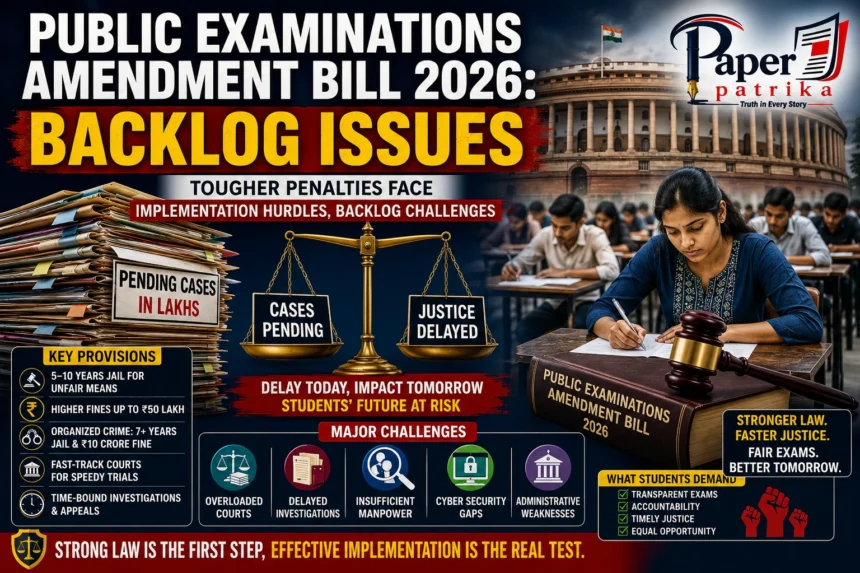
Public Examinations Amendment Bill 2026: Tougher Penalties Face Implementation Hurdles, Backlog Challenges.
By PaperPatrika National Desk
India has taken another significant step toward restoring public confidence in its examination system with the Lok Sabha passing the Public Examinations (Prevention of Unfair Means) Amendment Bill, 2026. The legislation, introduced after a series of high-profile paper leak controversies and widespread student protests, substantially strengthens punishments for examination fraud while introducing fast-track investigations and dedicated courts.
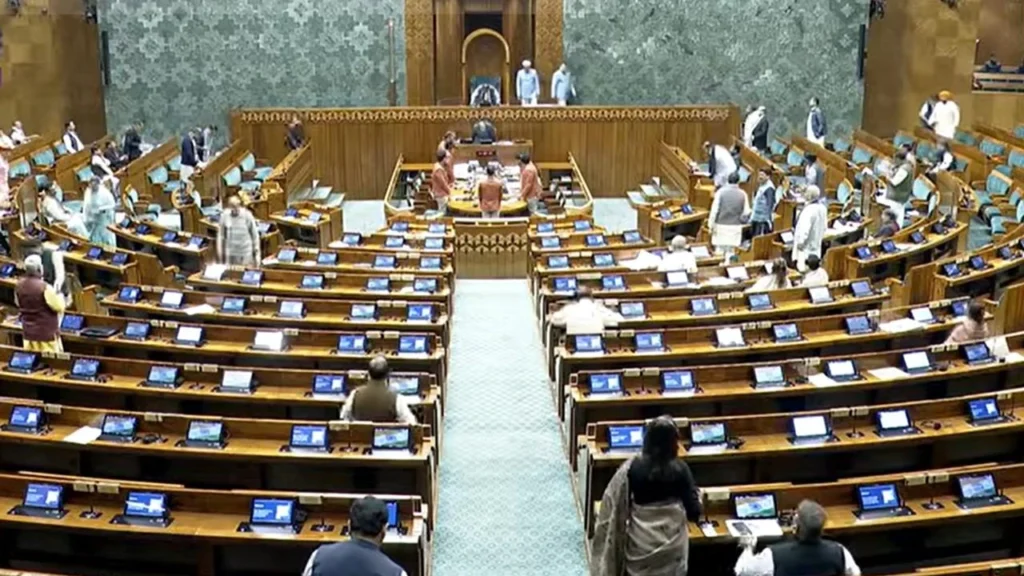
However, legal experts, education specialists, and opposition leaders argue that stronger penalties alone may not eliminate paper leaks. They warn that unless investigative agencies, examination authorities, and judicial institutions overcome existing implementation and case-backlog challenges, the law’s deterrent effect could remain limited. (Reuters)
Background: Why the Amendment Was Introduced
The amendment follows one of the biggest examination crises in recent years. Alleged leaks in competitive examinations, including NEET 2026, triggered nationwide protests by students demanding greater accountability and reforms in India’s recruitment and entrance examination system.
The original Public Examinations (Prevention of Unfair Means) Act, 2024 was enacted to curb cheating and paper leaks in examinations conducted by agencies such as:
- Union Public Service Commission (UPSC)
- National Testing Agency (NTA)
- Staff Selection Commission (SSC)
- Railway Recruitment Boards (RRBs)
- Institute of Banking Personnel Selection (IBPS)
- Central government recruitment bodies
The government concluded that the 2024 law required stronger enforcement provisions after continued incidents of organised examination fraud. (PRS Legislative Research)
What the Amendment Changes
The new legislation significantly increases punishments for individuals and organised networks involved in examination malpractice.

Among the major provisions are:
- Jail term for individuals using unfair means increased from 3–5 years to 5–10 years.
- Maximum fine increased from ₹10 lakh to ₹50 lakh.
- Organised crime involving paper leaks now attracts a minimum of 7 years’ imprisonment.
- Financial penalties for organised crime can reach ₹10 crore.
- Service providers involved in examination fraud face fines up to ₹5 crore and debarment from conducting examinations for 8 years.
- Dedicated Special Fast Track Courts for speedy trials.
- Time-bound investigations and appointment of Special Public Prosecutors.
- Faster disposal of appeals. (Press Information Bureau)
Government’s Stand
Introducing the Bill, Union Minister Dr. Jitendra Singh said the amendments are intended to strengthen fairness, transparency and credibility in India’s public examination system.
According to the government, stricter punishment alone is not the objective. The amendment also focuses on:
- Faster investigations
- Speedier trials
- Better institutional accountability
- Stronger deterrence against organised cheating syndicates
The government argues that millions of students depend on fair examinations for higher education and public employment, making examination integrity a national priority. (Press Information Bureau)
Why Experts Still See Challenges
Although education experts have welcomed tougher penalties, many caution that implementation remains the real test.
Several concerns continue to dominate discussions.
1. Investigation Capacity
Many examination fraud investigations involve cybercrime, encrypted communication, interstate criminal networks and financial transactions.
Without specialised investigative teams and adequate forensic resources, cases may still take months—or years—to conclude.
2. Judicial Backlogs
Fast-track courts have been proposed, but India’s judicial system already faces a substantial backlog of pending cases.
Experts note that merely creating special courts may not automatically guarantee speedy justice unless sufficient judges, prosecutors, and administrative staff are appointed. (Akashvani News)
3. Administrative Weaknesses
Paper leaks often occur due to:
- Weak digital security
- Insider involvement
- Poor logistics
- Inadequate monitoring
- Vendor failures
Critics argue these operational issues require administrative reforms alongside stronger criminal penalties. (Reuters)
Opposition’s Concerns
Opposition parties largely support stronger action against examination fraud but argue that the amendment focuses primarily on punishment rather than systemic reform.
Several MPs questioned:
- Whether higher penalties alone will prevent future leaks.
- Why earlier cases remain unresolved.
- Whether examination authorities themselves should face stronger accountability.
Some opposition members argued that restoring public trust requires transparent recruitment processes, technological upgrades and institutional reforms in addition to criminal law amendments. (Nation Press)
Importance of Fast-Track Courts
One of the amendment’s most significant provisions is the establishment of Special Fast Track Courts.
The Bill proposes:
- Completion of investigations within a prescribed period.
- Day-to-day hearings.
- Special prosecutors.
- Time-bound disposal of appeals.
Legal experts believe these measures could substantially reduce delays if implemented effectively across all states. (Press Information Bureau)
Technology Will Also Play a Key Role
Experts say modern examination security cannot rely solely on legal deterrence.
Future reforms may include:
- AI-based monitoring.
- Encrypted digital question paper delivery.
- Biometric candidate verification.
- Real-time surveillance.
- Blockchain-secured examination logistics.
- Multi-layer cyber security.
Government-appointed expert panels are also examining technology-driven reforms to minimise opportunities for organised paper leaks. (Reuters)
Impact on Students
For millions of aspirants preparing for examinations conducted by UPSC, SSC, NTA, Railways and banking recruitment agencies, the amendment offers reassurance that authorities are attempting to strengthen examination integrity.

However, students continue to seek:
- Timely examinations.
- Transparent investigations.
- Quick declaration of results.
- Accountability for officials responsible for security failures.
Student organisations have repeatedly emphasised that preventing paper leaks is more important than merely punishing offenders after the damage has already occurred. (Reuters)
Long-Term Outlook
The amendment represents one of the toughest anti-paper leak laws enacted in India.
Nevertheless, public policy experts suggest that its success will ultimately depend on:
- Efficient investigation.
- Timely prosecution.
- Strong cybersecurity.
- Administrative accountability.
- Institutional reforms.
- Transparent examination governance.
Only by combining legal deterrence with operational improvements can India fully restore public confidence in competitive examinations.
Conclusion
The Public Examinations (Prevention of Unfair Means) Amendment Bill, 2026 marks a decisive attempt to crack down on organised examination fraud through harsher penalties, faster investigations and dedicated courts. While the legislation strengthens India’s legal framework against paper leaks, experts caution that the real challenge lies in implementation.
Without modern examination security systems, efficient investigations, well-functioning fast-track courts and comprehensive administrative reforms, tougher punishments alone may not eliminate examination malpractice. As millions of students continue to depend on transparent and credible recruitment and entrance examinations, the success of the amendment will ultimately be measured not by the severity of its penalties, but by its ability to prevent future paper leaks and deliver timely justice.