

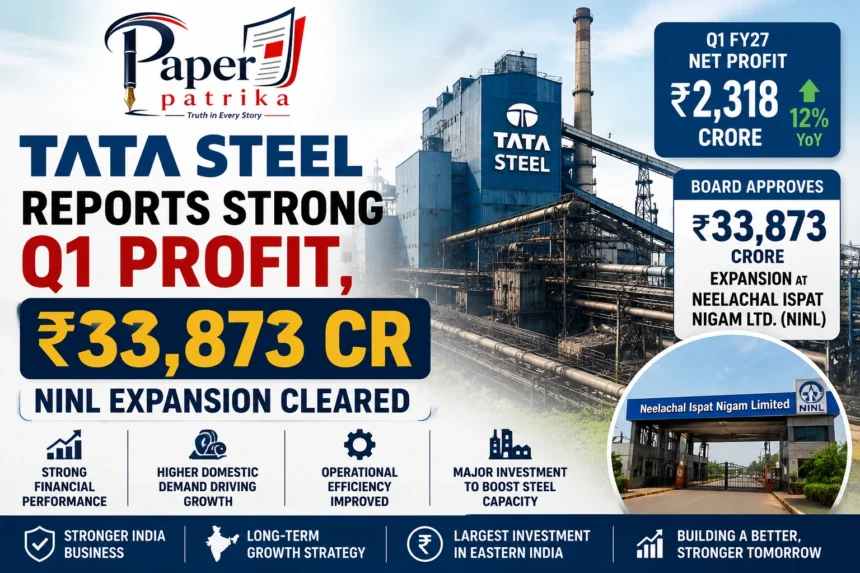
Tata Steel Reports Strong Q1 Performance; Net Profit Rises to ₹2,318 Crore, Board Clears ₹33,873 Crore Neelachal Ispat Expansion.
By PaperPatrika Business Desk
India’s largest steel producer, Tata Steel Ltd., has reported a robust start to FY2026–27, posting a consolidated net profit of ₹2,318 crore for the quarter ended June 30, 2026. The company attributed the improvement to resilient domestic demand, higher production in India, and stronger operational performance, even as global steel markets continued to face pricing pressures and macroeconomic uncertainty. The company also announced one of its largest domestic investment decisions in recent years, with its Board approving a ₹33,873 crore capital expenditure plan to expand the capacity of Neelachal Ispat Nigam Ltd. (NINL). (The Economic Times)
The financial results and expansion announcement reinforce Tata Steel’s long-term strategy of strengthening its manufacturing footprint in India while modernising production assets and meeting the country’s rising steel demand.
Strong Quarterly Financial Performance
For the April–June 2026 quarter, Tata Steel reported a consolidated net profit of ₹2,318 crore, representing a year-on-year increase of around 12% according to the company’s earnings announcement. The performance exceeded market expectations and reflected healthy operations in its Indian business despite mixed global conditions. (The Economic Times)
Revenue remained supported by healthy domestic steel demand, while operational efficiencies and cost-management initiatives helped improve profitability.
Management stated that India continued to be the primary growth engine, offsetting weaker conditions in some overseas markets.
India Business Continues to Drive Growth
Tata Steel’s domestic operations remained the biggest contributor to quarterly earnings.
Higher production volumes, improved product mix and sustained infrastructure demand supported the company’s performance. Earlier provisional operational data had already indicated an increase in Indian crude steel production and deliveries during the quarter. (Tata Steel)
Demand from sectors such as:
- Infrastructure
- Construction
- Automotive
- Engineering
- Capital goods
continued to provide stability despite volatility in international steel prices.
Massive ₹33,873 Crore Investment in NINL
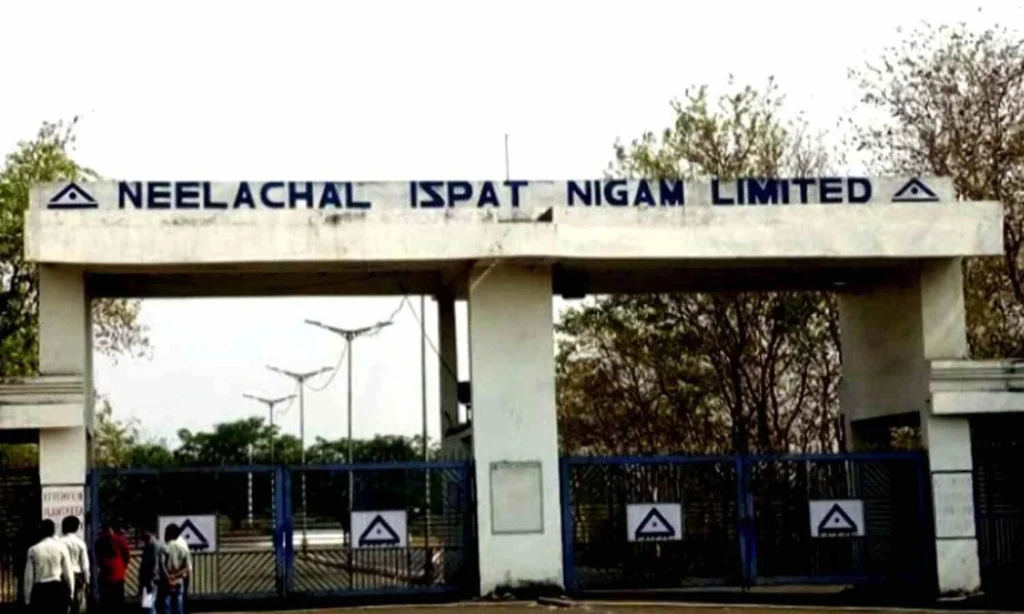
The biggest announcement alongside the quarterly results was the Board’s approval of a ₹33,873 crore investment for expanding Neelachal Ispat Nigam Ltd. (NINL).
The project is expected to significantly enhance production capacity, modernise facilities and strengthen Tata Steel’s presence in eastern India.
According to the company, the investment aligns with its long-term objective of increasing domestic steelmaking capacity and supporting India’s industrial growth. (The Economic Times)
What is Neelachal Ispat Nigam?
Neelachal Ispat Nigam Ltd., located in Odisha, became part of the Tata Steel group after its acquisition in 2025.
Since the acquisition, Tata Steel has been working to integrate NINL into its broader manufacturing network while improving operational efficiency and production capability. The company had also earlier approved the merger of NINL into Tata Steel as part of its long-term corporate restructuring strategy. (The Economic Times)
The latest investment represents the next major phase in transforming NINL into a modern integrated steel facility.
Strategic Importance of the Expansion
Industry analysts view the expansion as strategically significant for several reasons:
- Higher steel production capacity.
- Better utilisation of Odisha’s mineral resources.
- Improved operational efficiency.
- Greater economies of scale.
- Stronger supply chain integration.
- Support for India’s infrastructure expansion.
The project is also expected to generate employment during both construction and operational phases.
Market Reaction
Investors responded positively to the earnings announcement, noting that the profit growth came despite challenging global market conditions.
Analysts highlighted several positives:
- Earnings exceeded expectations.
- Strong India business.
- Large domestic investment commitment.
- Continued focus on long-term growth.
- Stable balance sheet and operational discipline.
The expansion announcement was viewed as a signal of management’s confidence in India’s long-term steel demand.
India’s Growing Steel Demand
India remains one of the fastest-growing steel markets globally.
Government initiatives including:
- National Infrastructure Pipeline
- Railway modernisation
- Affordable housing
- Renewable energy projects
- Urban development
- Manufacturing expansion
continue to create sustained demand for steel products.
Tata Steel’s investment strategy closely aligns with these long-term infrastructure requirements.
Operational Improvements
Besides higher production, Tata Steel has focused on:
- Cost optimisation.
- Digital manufacturing.
- Energy efficiency.
- Product quality improvements.
- Supply-chain optimisation.
Earlier operational updates showed improved crude steel production and delivery volumes in India during the first quarter of FY27. (Tata Steel)
These improvements have helped strengthen margins despite fluctuations in raw-material prices.
Challenges Remain
While India’s outlook remains positive, Tata Steel continues to face external challenges including:
- Global steel oversupply.
- Volatile coking coal prices.
- Geopolitical uncertainty.
- Weak demand in some overseas markets.
- Currency fluctuations.
Management has reiterated that disciplined capital allocation and operational excellence will remain key priorities.
Long-Term Capacity Vision
At its recent Annual General Meeting, Tata Steel reaffirmed its ambition to significantly expand domestic steelmaking capacity over the coming years.
The NINL expansion represents another important milestone in achieving that long-term objective while strengthening India’s manufacturing ecosystem. (Reddit)
Industry Outlook
Steel industry experts expect domestic demand to remain resilient because of continued public and private sector investments.
Large infrastructure projects, industrial corridors, manufacturing incentives and urbanisation are expected to support steel consumption over the next decade.
Companies with modern production facilities and strong domestic market exposure are likely to benefit the most.
Conclusion
Tata Steel’s first-quarter performance demonstrates the resilience of its India-focused strategy. With consolidated net profit rising to ₹2,318 crore and the approval of a ₹33,873 crore expansion project at Neelachal Ispat Nigam Ltd., the company has combined strong financial execution with a bold long-term investment plan.
The earnings underline the strength of Tata Steel’s domestic operations, while the NINL expansion reflects confidence in India’s future industrial growth. As infrastructure spending accelerates and steel demand continues to rise, the company appears well positioned to strengthen its leadership in the Indian steel sector while creating long-term value for shareholders, employees and the broader economy.
Also Read: –
Delhi Transport Unions Announce ‘E-20’ Protest March to Parliament on August 4: Fuel Policy Sparks Fresh Debate
NITI Aayog’s Investment Friendliness Index: Gujarat and Maharashtra Emerge as India’s Top Investment Destinations