

By PaperPatrika International Desk
A proposal to move massive artificial intelligence (AI) data centers into space has sparked a major environmental debate, with scientists, former space officials, and environmental organizations warning that such projects could have severe and potentially irreversible consequences for Earth’s atmosphere and the space environment.
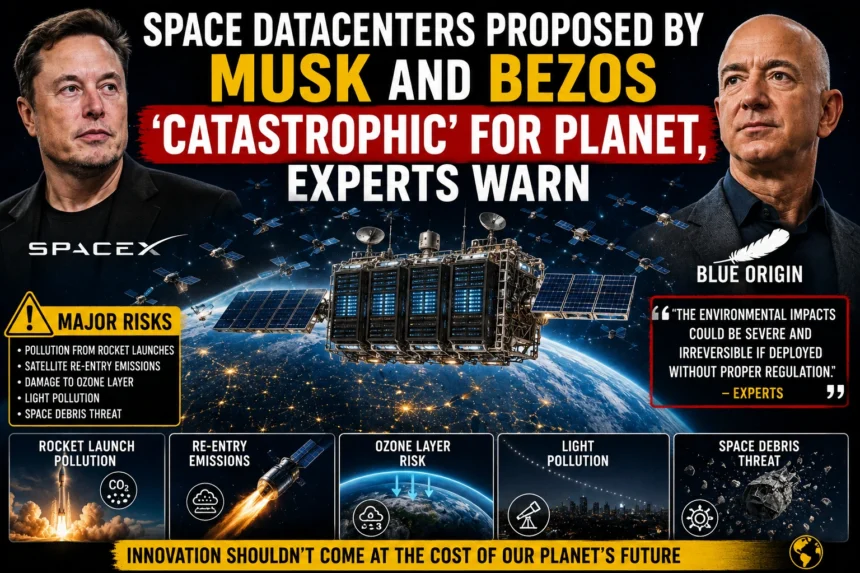
The controversy centres on ambitious plans associated with companies including Elon Musk’s SpaceX and Jeff Bezos’ Blue Origin, which have explored concepts for orbital data centres—large computing facilities powered by continuous solar energy in space. Supporters argue that space-based infrastructure could reduce pressure on Earth’s electricity grids and water resources, while critics say the environmental costs have been underestimated and insufficiently studied. (The Guardian)
What Are Orbital Data Centres?
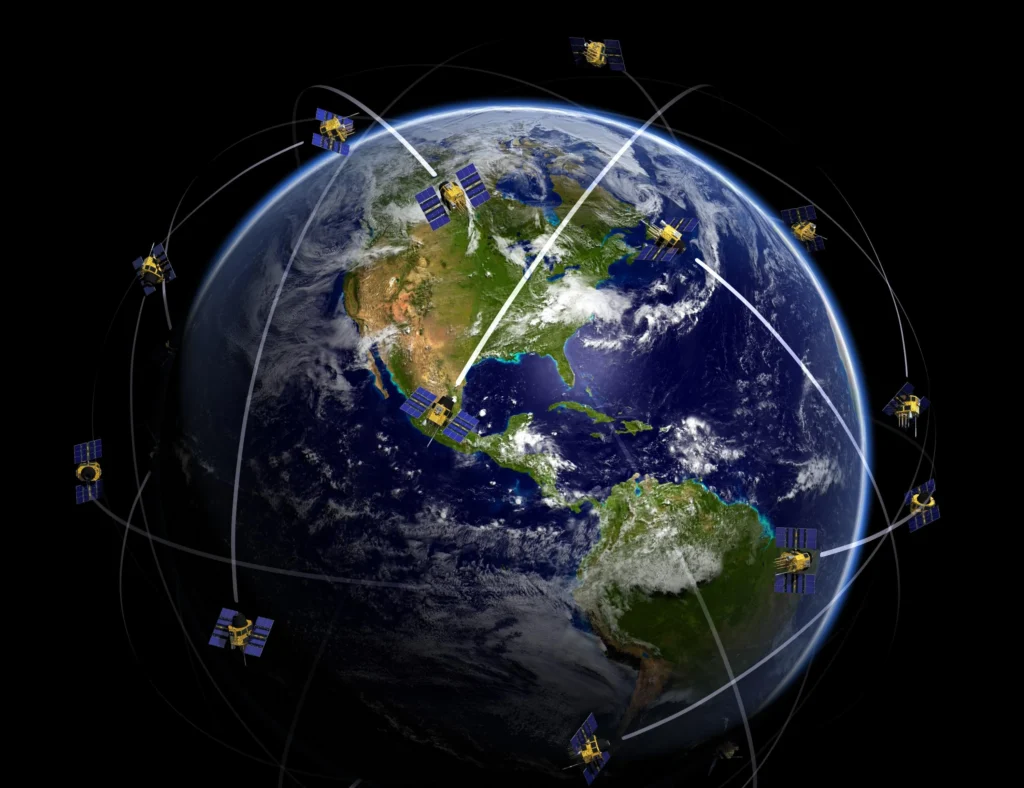
Orbital data centres are proposed computing facilities located in Earth orbit rather than on the planet’s surface. Instead of relying on terrestrial power grids, these facilities would operate using nearly continuous solar energy collected in space.
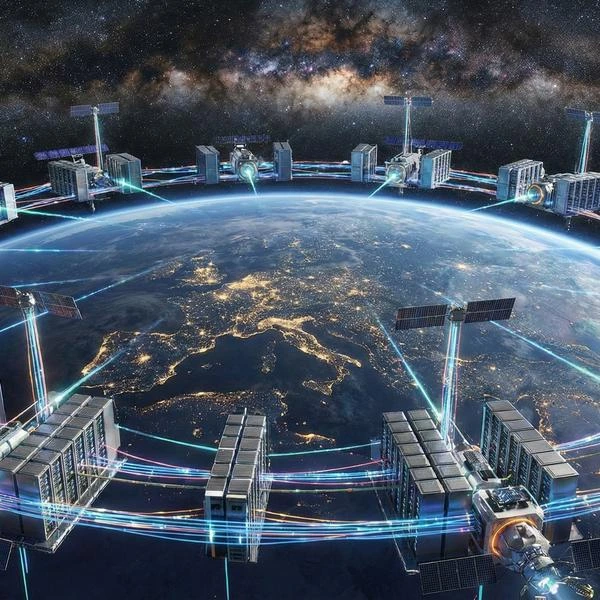
Technology companies believe such systems could eventually support:
- Artificial intelligence (AI) workloads
- Cloud computing services
- Scientific simulations
- Space-based communications
- Future lunar and deep-space missions
Advocates argue that relocating energy-intensive computing to space could reduce land use, electricity consumption from conventional grids, and freshwater demand for cooling large terrestrial data centres. However, significant engineering challenges—including heat dissipation, maintenance, and launch costs—remain unresolved. (Government Accountability Office)
Environmental Groups Seek Regulatory Pause
A coalition of environmental organizations, including Earthjustice, Public Employees for Environmental Responsibility (PEER), and Dark-Sky International, has petitioned the U.S. Federal Communications Commission (FCC) to pause approvals for new orbital data-centre projects.
The petition argues that companies have not conducted comprehensive environmental assessments before seeking licenses for potentially millions of additional satellites.
According to the coalition, federal environmental laws require a more detailed review before projects of this scale are approved. (The Guardian)
Pollution Concerns Extend Beyond Earth
Experts warn that the environmental impact is not limited to launches.
Every rocket launch releases pollutants such as:
- Black carbon (soot)
- Nitrogen oxides
- Aluminum oxide
- Chlorine compounds
When satellites eventually re-enter Earth’s atmosphere at the end of their operational life, they vaporize, releasing metals and other particles into the stratosphere.
Scientists say these emissions are accumulating in atmospheric layers that play a crucial role in regulating Earth’s climate and protecting the ozone layer. While the long-term effects remain uncertain, researchers believe the potential risks warrant much closer scientific investigation before orbital infrastructure expands dramatically. (The Guardian)
Possible Threat to the Ozone Layer
One of the biggest concerns involves the interaction between spacecraft emissions and the stratosphere.
Recent scientific studies have detected metallic particles from satellite re-entries in stratospheric aerosols—tiny particles that influence atmospheric chemistry and Earth’s radiation balance.
Researchers fear that increasing concentrations of soot, aluminum oxides, and metallic particles could:
- Alter atmospheric chemistry.
- Damage the ozone layer.
- Increase ultraviolet (UV) radiation reaching Earth’s surface.
- Affect global climate systems.
Scientists emphasize that the exact consequences remain uncertain, but they argue uncertainty should not justify proceeding without environmental review. (The Guardian)
Light Pollution Could Intensify
Another major issue is light pollution.
Environmental experts warn that launching hundreds of thousands—or even millions—of additional satellites could significantly brighten the night sky.
Such changes could:
- Disrupt astronomical observations.
- Affect wildlife that relies on natural darkness.
- Reduce visibility of stars.
- Interfere with scientific research conducted by ground-based observatories.
Astronomers have warned that future satellite megaconstellations and orbital infrastructure could fundamentally change humanity’s view of the night sky if not properly regulated. (Space)
Are the Projects Technically Feasible?
Interestingly, several former U.S. space officials have questioned whether orbital data centers are practical at all.

Unlike on Earth, space offers no atmosphere for conventional cooling. Servers would have to rely on large radiators to dissipate heat, making thermal management one of the biggest engineering obstacles.
Additional challenges include:
- Extremely high launch costs.
- Radiation exposure affecting electronics.
- Space debris risks.
- Maintenance and repair difficulties.
- Reliable communication latency.
Government assessments note that these engineering issues remain substantial and have yet to be solved at commercial scale. (Government Accountability Office)
Why Companies Are Interested
Despite the criticism, interest in orbital computing continues to grow because AI requires enormous computing power.
Modern AI systems consume vast quantities of electricity and water through conventional data centres.
Supporters believe space could eventually provide:
- Continuous solar power.
- Reduced dependence on terrestrial infrastructure.
- Scalable computing capacity for future space economies.
However, critics argue that moving computing infrastructure into orbit merely shifts environmental impacts rather than eliminating them. (Down To Earth)
Calls for Stronger Regulation
Environmental organizations are not asking governments to permanently ban orbital data centers.
Instead, they seek:
- Comprehensive environmental impact assessments.
- Independent scientific review.
- Greater transparency from technology companies.
- International coordination on space governance.
- Clear regulations before large-scale deployment.
Experts argue that existing space regulations were not designed for millions of AI satellites operating simultaneously. (The Guardian)
Industry Response
Companies developing orbital computing concepts maintain that space technology can play an important role in supporting future digital infrastructure.
Proponents say continuous innovation and improved spacecraft design could eventually reduce environmental impacts.
However, critics argue that current applications contain few concrete details explaining how atmospheric pollution, satellite disposal, thermal management, and cumulative environmental effects would be mitigated. (The Guardian)
Broader Implications
The debate extends beyond a single technology.
It raises important questions about:
- Sustainable AI development.
- Responsible commercialization of space.
- Environmental governance.
- Long-term orbital sustainability.
- Balancing technological innovation with ecological protection.
As AI demand accelerates worldwide, governments may increasingly face difficult decisions about where future computing infrastructure should be built and how its environmental costs should be managed. (ScienceDirect)
What Happens Next?
The FCC is expected to review the petition submitted by environmental organizations before deciding whether additional licenses for large orbital data-centre projects should proceed.
Scientists are calling for more atmospheric research, international cooperation, and transparent environmental studies before any large-scale deployment of orbital computing infrastructure.
Whether these projects ultimately become commercially viable or remain largely conceptual, the debate has highlighted the growing intersection of AI, space technology, and environmental policy. (The Guardian)
Conclusion
The proposal to place AI data centres in orbit represents one of the most ambitious ideas in modern technology. While supporters see orbital computing as a way to meet soaring AI demand without overwhelming Earth’s infrastructure, environmental scientists caution that the environmental costs could be significant if deployment occurs without adequate oversight.
The current dispute is therefore not simply about satellites—it is about ensuring that technological innovation proceeds alongside rigorous environmental assessment, transparent regulation, and international cooperation. As policymakers evaluate the next generation of space infrastructure, the balance between innovation and sustainability is likely to become one of the defining debates of the AI era.
Also Read: – India’s First Private Orbital Rocket Ready for Launch: ‘Mission Aagaman’ Marks a Historic Milestone in India’s Space Journey
India’s Second Astronaut Shubhanshu Shukla Reaches the International Space Station: A Historic Milestone in India’s Space Journey