
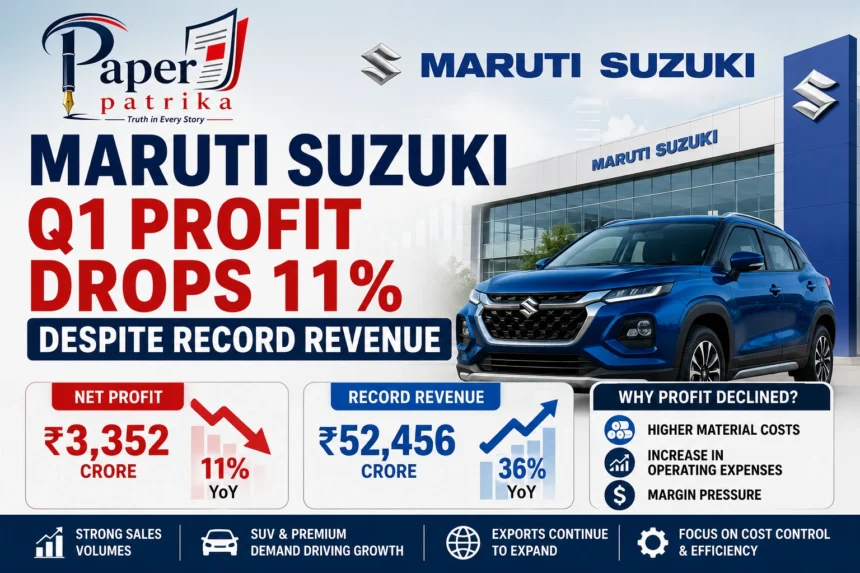
Maruti Suzuki Q1 Net Profit Falls 11% to ₹3,352 Crore Despite Record Revenue Growth; Higher Material Costs Weigh on Margins.
By PaperPatrika Business Desk
India’s largest passenger vehicle manufacturer, Maruti Suzuki India Ltd., reported a mixed set of financial results for the first quarter of FY2026–27, posting an 11% year-on-year decline in consolidated net profit to ₹3,352 crore for the quarter ended June 30, 2026. While the company achieved record quarterly revenue of ₹52,456 crore, rising 36% year-on-year, escalating raw material costs and higher operating expenses compressed profit margins. (The Economic Times)
The results underline the resilience of demand for Maruti Suzuki vehicles in the domestic and export markets, but also highlight the challenges facing automobile manufacturers as commodity prices remain elevated.
Profit Declines Despite Strong Sales
Maruti Suzuki reported a consolidated net profit of ₹3,352 crore, down from ₹3,758 crore in the corresponding quarter of the previous financial year. The decline was mainly attributed to rising costs of key raw materials such as steel and other commodities, which increased production expenses. (The Economic Times)
Although the earnings met market expectations, the decline reflects continued pressure on profitability despite robust vehicle sales.
Record Revenue Driven by Higher Volumes
One of the biggest highlights of the quarter was the company’s record revenue from operations of ₹52,456 crore, representing a 36% year-on-year increase.
The strong top-line performance was supported by:
- Record vehicle sales volumes
- Higher export shipments
- Improved product mix
- Better average realizations
- Continued demand for SUVs and premium models
The company’s revenue growth significantly outpaced the increase in profits because production costs rose even faster. (The Economic Times)
Rising Input Costs Hurt Margins
Management stated that increasing prices of steel, precious metals, and other automotive inputs significantly impacted operating margins.
Global commodity inflation, along with supply-chain costs linked to geopolitical tensions, especially in West Asia, continued to affect manufacturing expenses. Even though Maruti Suzuki implemented selective price increases across several models, these measures were insufficient to fully offset higher input costs. (reuters.com)
Expenses Grow Faster Than Revenue
During the quarter:
- Revenue increased by 36%
- Total expenses rose by over 40%
The sharper rise in expenditure resulted in lower operating profitability despite healthy sales growth. Higher raw material consumption remained the single largest factor behind margin pressure. (reuters.com)
Domestic Demand Remains Healthy
Despite profitability challenges, Maruti Suzuki continued to benefit from steady demand in the Indian passenger vehicle market.
Key growth drivers included:
- Strong SUV demand
- Rural market recovery
- Festive season bookings
- Higher replacement demand
- Continued preference for fuel-efficient vehicles
The company also maintained strong momentum in exports, reinforcing India’s position as an important manufacturing hub for Suzuki’s global operations.
SUV Portfolio Continues to Expand
Maruti Suzuki’s SUV lineup—including the Brezza, Grand Vitara, Fronx, Jimny, and Invicto—continued to contribute significantly to overall sales.
The shift toward higher-value SUVs has helped improve average selling prices, although higher manufacturing costs have partly offset these gains.
Industry analysts expect SUVs to remain the company’s primary growth engine over the coming years.
Export Performance Adds Strength
Exports remained another major contributor to the company’s quarterly performance.
Maruti Suzuki has been steadily increasing shipments to Africa, Latin America, the Middle East, and other international markets.
Growing exports provide diversification beyond domestic demand and strengthen the company’s long-term growth outlook.
Industry Challenges Continue
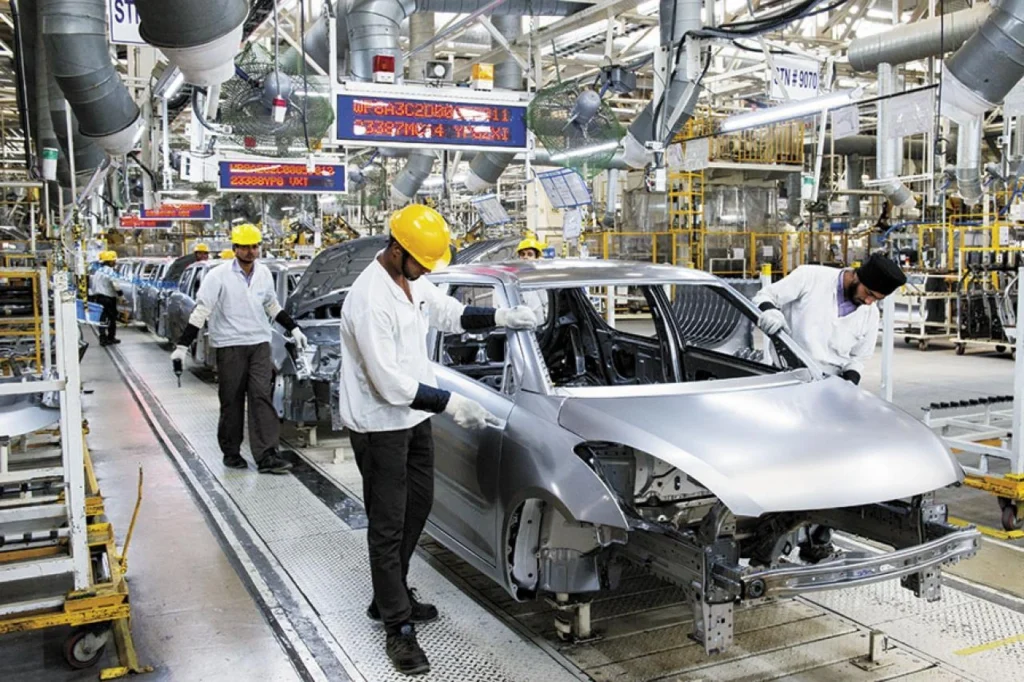
The automobile sector continues to face multiple headwinds:
- High steel prices
- Rising aluminum costs
- Currency fluctuations
- Freight expenses
- Supply-chain disruptions
- Global geopolitical uncertainty
These factors have increased manufacturing costs across the industry and affected profitability for several automakers.
Management Outlook
Maruti Suzuki remains optimistic about medium-term growth, supported by:
- Rising disposable incomes
- Infrastructure development
- Expanding rural demand
- Growing SUV market
- Increasing exports
- Government support for manufacturing
The company also expects production efficiencies and cost-control measures to gradually improve margins as commodity prices stabilize.
Investor Perspective
Despite the decline in quarterly profit, analysts viewed the results as broadly in line with expectations because:
- Revenue reached an all-time quarterly high.
- Vehicle volumes remained strong.
- Market share stayed healthy.
- Export momentum continued.
- Demand outlook remained positive.
Investors will closely monitor future quarters to assess whether raw material prices moderate and operating margins improve.
India’s Passenger Vehicle Market
India continues to be one of the world’s fastest-growing automobile markets.
Growth is being supported by:
- Urbanization
- Rising middle-class incomes
- Better financing availability
- Highway expansion
- Replacement demand
- Increasing preference for personal mobility
These structural trends continue to provide long-term opportunities for manufacturers such as Maruti Suzuki.
Looking Ahead
Maruti Suzuki is expected to focus on:
- Improving manufacturing efficiency
- Expanding SUV offerings
- Strengthening exports
- Managing raw-material costs
- Investing in cleaner technologies
- Enhancing customer experience
Analysts believe these initiatives will support sustainable growth even if short-term cost pressures persist.
Conclusion
Maruti Suzuki’s first-quarter FY2027 results present a picture of strong business momentum but compressed profitability. While net profit declined 11% to ₹3,352 crore, the company achieved a record quarterly revenue of ₹52,456 crore, reflecting healthy demand for its vehicles. Rising material costs—particularly steel and other commodities—remained the primary challenge, offsetting the benefits of higher sales volumes.
With a dominant position in India’s passenger vehicle market, a growing SUV portfolio, and expanding exports, Maruti Suzuki remains well placed for long-term growth. However, its near-term profitability will depend largely on how quickly commodity prices stabilize and whether ongoing cost-control initiatives translate into stronger operating margins.
Also Read: – Tata Steel Reports Strong Q1 Profit; ₹33,873 Cr NINL Expansion Cleared